


Checking and securing calculating probabilities from tables
I can calculate probabilities from tables and two-way tables.


- Year 11
Checking and securing calculating probabilities from tables
I can calculate probabilities from tables and two-way tables.
Lesson details
Key learning points
- The probability of an outcome can be found by considering a table
- The probability of an event can be found by considering a table showing all possible outcomes
- The probability of an outcome can be found by considering a two-way table showing all possible outcomes for two events
- The probability of an event can be found by considering a two-way table showing all possible outcomes for two events
Keywords
Probability - The probability that an event will occur is the proportion of times the event is expected to happen in a suitably large experiment.
Frequency - The frequency is the number of times an event occurs; or the number of individuals (people, animals etc.) with some specific property.
Common misconception
Pupils may get confused between two-way tables that show outcomes and two-way tables that show frequencies (particularly when the outcomes are numbers, such as the sum of two dice rolls).
Two-way tables can be either used to display the sample space of individual outcomes or the frequencies of outcomes. Therefore, when using a table, it can be helpful to note down what type of data the table shows.


Licence
Lesson video
Loading...
Prior knowledge starter quiz
6 Questions
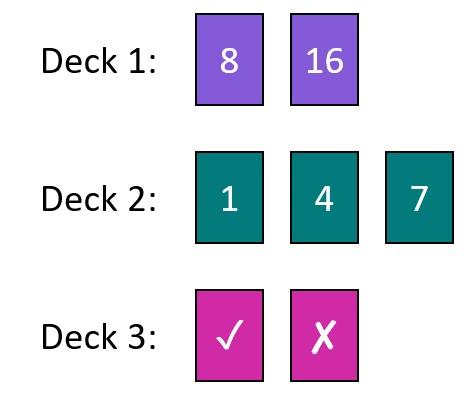
Q1.Here are three decks of cards.
A single card from each of Deck 1, Deck 2, and Deck 3 is drawn to make a trio.
What is the probability that this trio of cards contains a square number?

Q2.Sam plays a video game that can either be won or lost.
The probability that Sam wins the video game is 0.42.
The probability that Sam loses the video game is .
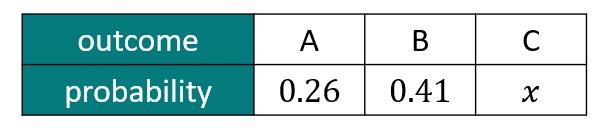
Q3.This table shows the mutually exclusive and exhaustive set of outcomes, and the probability of each outcome, from spinning a spinner once.
The value of $$x$$ is .
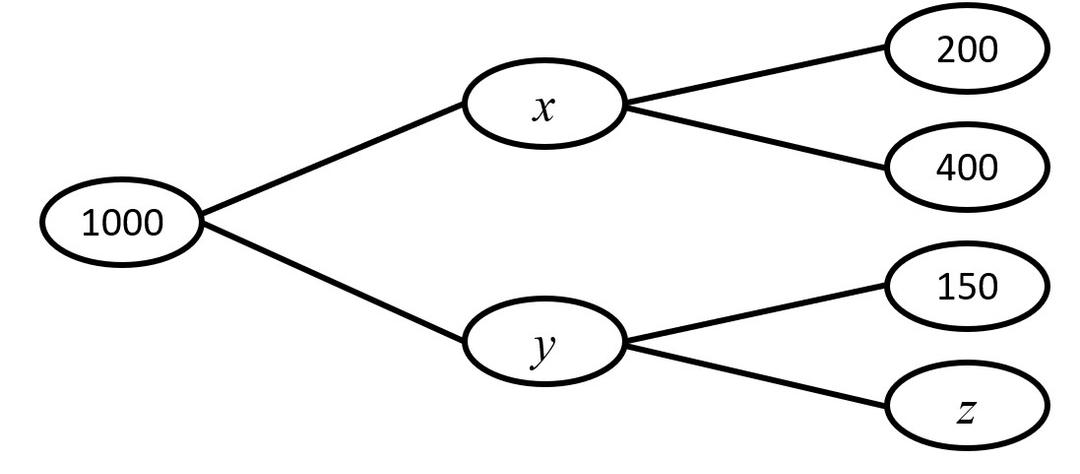
Q4.Which of these statements are correct for this frequency tree?
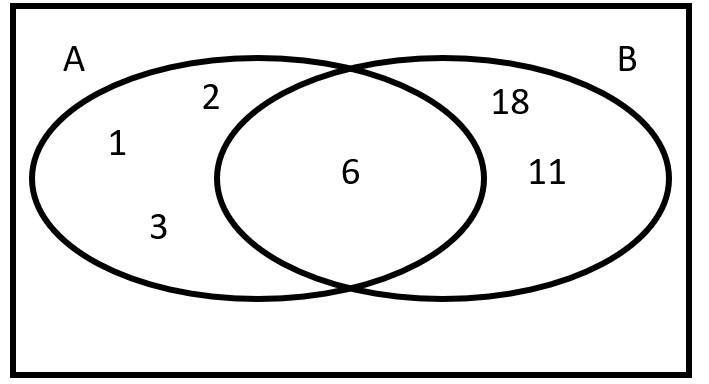
Q5.Each card on a deck of 7 cards has a unique integer written on it. A = {factors of 6}, B = {numbers ≥ 6}.
What positive integer could be on the seventh card for events A and B to not be exhaustive?
Q6.A game can either be won by either Alex, Sam, or Jacob.
P(Sam wins) = .

Assessment exit quiz
6 Questions
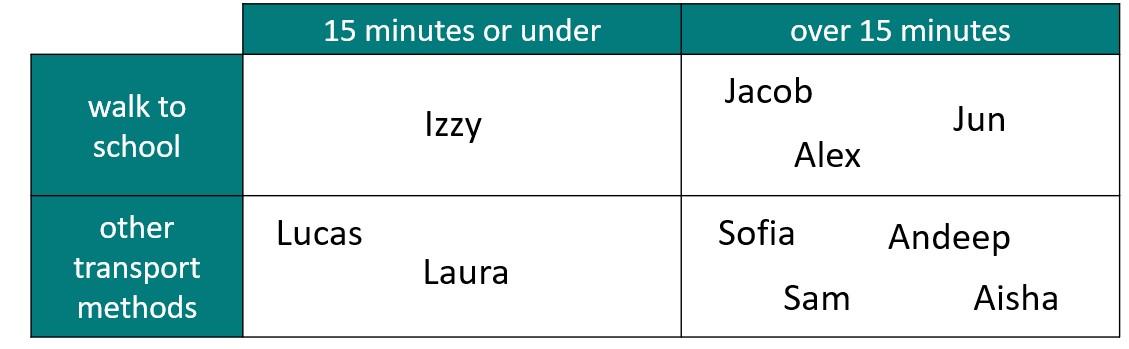
Q1.Students were asked whether they walked to school or used other transport methods, and how long their journey took them. Find the probability a student had a journey of over 15 minutes.
Q2.A spinner with outcomes {1, 2, 3, 5, 9, 15} is spun twice. The outcome of each spin is added together.
Find P(multiple of 10).
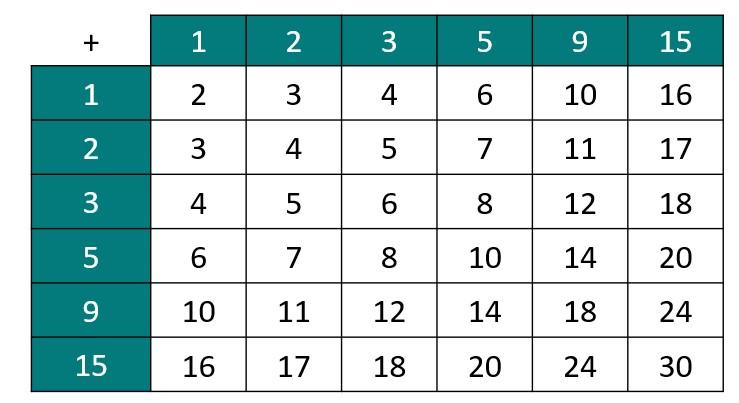
Q3.A spinner with outcomes {1, 2, 3, 5, 9, 15} is spun twice. The outcome of each spin is added together.
Find P(not a prime number).
Q4.People at a bus station were surveyed their age and where their destination was.
Match each frequency from the table to its value.
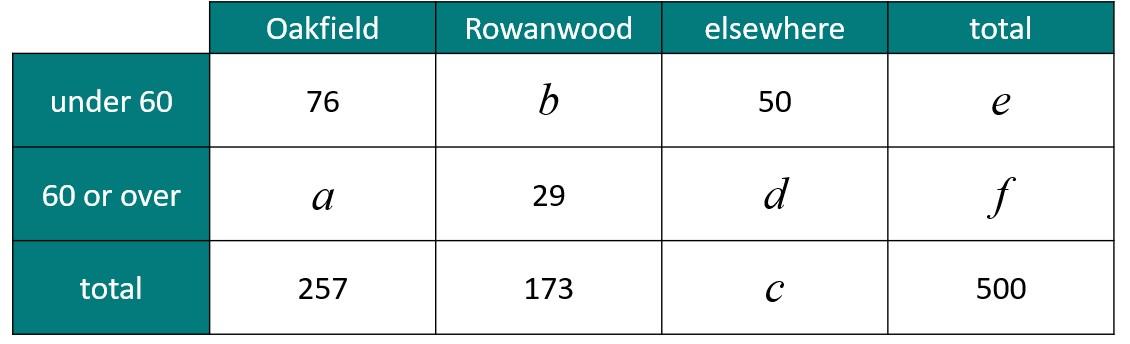
$$a$$ - 181
$$b$$ - 144
$$c$$ - 70
$$d$$ - 20
$$e$$ - 270
$$f$$ - 230
Q5.People at a bus station were surveyed their age and where their destination was.
A person is chosen at random.
Find P(60 or over and going to Rowanwood).
Q6.People at a bus station were surveyed their age and where their destination was.
A person going to Oakfield is chosen at random.
Find P(under 60).
