


New
New
Checking and securing exhaustive events
I can work with probabilities as fractions, decimals and percentages and use the fact that exhaustive events sum to 1.


Lesson 2 of 18
New
New
- Year 11
Checking and securing exhaustive events
I can work with probabilities as fractions, decimals and percentages and use the fact that exhaustive events sum to 1.
Lesson details
Key learning points
- Probabilities can be given as fractions, decimals or percentages
- An event is exhaustive if all possible outcomes are included
- The probability of an exhaustive event is 1 and this can be used to calculate missing probabilities
Keywords
Mutually exclusive - Two or more events are mutually exclusive if they share no common outcome.
Exhaustive events - A set of events are exhaustive if at least one of them has to occur whenever the experiment is carried out.
Common misconception
Pupils may think that any set of probabilities relating to a scenario will always sum to 1.
Probabilities sum to 1 when the events are exhaustive and mutually exclusive.
Pupils could be asked to come up with the own examples of events that are mutually exclusive and exhaustive for different scenarios (e.g. when rolling a dice).

Teacher tip

Licence
This content is © Oak National Academy Limited (2025), licensed on Open Government Licence version 3.0 except where otherwise stated. See Oak's terms & conditions (Collection 2).
Lesson video
Loading...
Prior knowledge starter quiz
6 Questions
Q1.Each card in a deck of 10 cards has a unique integer from 1 to 10 written on it. There are factors of 12 in the deck.
Each card in a deck of 10 cards has a unique integer from 1 to 10 written on it. There are factors of 12 in the deck.
Correct Answer: 5, five

5, five
Q2.Each card in a deck of 10 cards has a unique integer from 1 to 10 written on it.
A single random card is drawn.
What is the probability of that card being a factor of 12?
Each card in a deck of 10 cards has a unique integer from 1 to 10 written on it.
A single random card is drawn.
What is the probability of that card being a factor of 12?
$$\frac{4}{10}$$
Correct answer: $$\frac{5}{10}$$
$$\frac{5}{10}$$
$$\frac{5}{12}$$
Correct answer: $$\frac{1}{2}$$
$$\frac{1}{2}$$
$$\frac{2}{5}$$
Q3.Each card in a deck of 10 cards has a unique integer from 1 to 10 written on it.
A single random card is drawn.
Match each event to its likelihood.
Each card in a deck of 10 cards has a unique integer from 1 to 10 written on it.
A single random card is drawn.
Match each event to its likelihood.
Correct Answer:P(greater than 20),impossible
P(greater than 20) - impossible
Correct Answer:P(square),unlikely
P(square) - unlikely
Correct Answer:P(odd),even chance
P(odd) - even chance
Correct Answer:P(single digit),likely
P(single digit) - likely
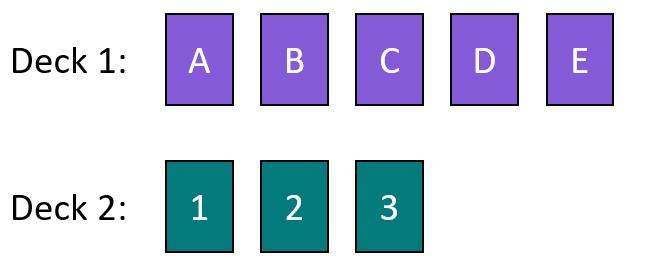
Q4.Here are two decks of cards.
A single card from Deck 1 and a single card from Deck 2 is drawn to make a pair.
There are possible outcomes for drawing one card from each deck.
Here are two decks of cards.
A single card from Deck 1 and a single card from Deck 2 is drawn to make a pair.
There are possible outcomes for drawing one card from each deck.
Correct Answer: 15, fifteen
15, fifteen
Q5.Here are two decks of cards. A single card from Deck 1 and a single card from Deck 2 is drawn to make a pair.
What is the probability that this pair of cards contains a B?
Here are two decks of cards. A single card from Deck 1 and a single card from Deck 2 is drawn to make a pair.
What is the probability that this pair of cards contains a B?
$$\frac{5}{15}$$
Correct answer: $$\frac{3}{15}$$
$$\frac{3}{15}$$
$$\frac{1}{3}$$
Correct answer: $$\frac{1}{5}$$
$$\frac{1}{5}$$
$$\frac{1}{15}$$
Q6.Here are two decks of cards.
A single card from Deck 1 and a single card from Deck 2 is drawn to make a pair.
What is the probability that this pair of cards doesn't contain an odd number?
Here are two decks of cards.
A single card from Deck 1 and a single card from Deck 2 is drawn to make a pair.
What is the probability that this pair of cards doesn't contain an odd number?
$$\frac{3}{15}$$
Correct answer: $$\frac{5}{15}$$
$$\frac{5}{15}$$
$$\frac{6}{15}$$
$$\frac{2}{3}$$
Correct answer: $$\frac{1}{3}$$
$$\frac{1}{3}$$
Assessment exit quiz
6 Questions
Q1.Each face on an 8-sided die has a unique integer from 1 to 8 written on it.
The Venn diagram shows Event A = {factors of 12} and Event B = {even numbers}.
Which of these statements are correct?
Each face on an 8-sided die has a unique integer from 1 to 8 written on it.
The Venn diagram shows Event A = {factors of 12} and Event B = {even numbers}.
Which of these statements are correct?
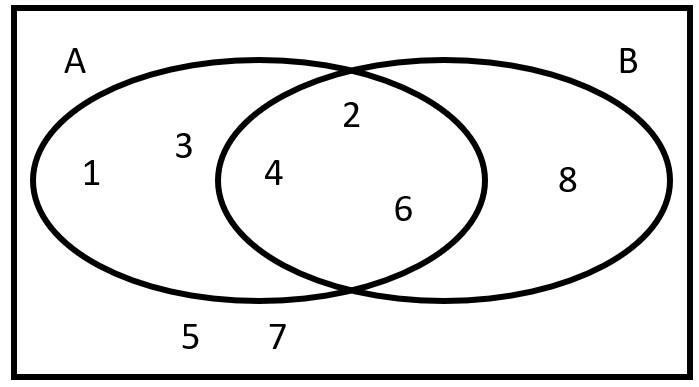
Events A and B are exhaustive.
Correct answer: Events A and B are not exhaustive.
Events A and B are not exhaustive.
Correct answer: The outcomes 5 and 7 are not in either event A or event B.
The outcomes 5 and 7 are not in either event A or event B.
Events A and B are mutually exclusive.
Correct answer: Events A and B are not mutually exclusive.
Events A and B are not mutually exclusive.
Q2.Each face on an 8-sided die has a unique integer from 1 to 8 written on it.
The Venn diagram shows Event A = {factors of 24} and Event B = {odd numbers}.
Which of these statements are correct?
Each face on an 8-sided die has a unique integer from 1 to 8 written on it.
The Venn diagram shows Event A = {factors of 24} and Event B = {odd numbers}.
Which of these statements are correct?
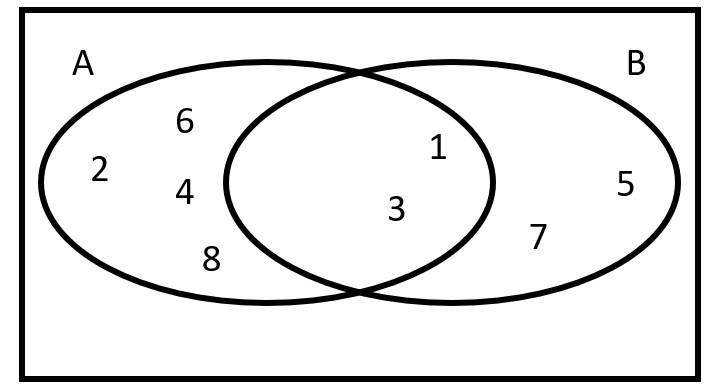
Correct answer: Events A and B are exhaustive.
Events A and B are exhaustive.
Events A and B are not exhaustive.
The outcomes 1 and 3 are not in either event A or event B.
Events A and B are mutually exclusive.
Correct answer: Events A and B are not mutually exclusive.
Events A and B are not mutually exclusive.
Q3.Each face on an 8-sided die has a unique integer from 1 to 8 written on it.
The Venn diagram shows Event A = {multiples of 4} and Event B = {prime numbers}.
Which of these statements are correct?
Each face on an 8-sided die has a unique integer from 1 to 8 written on it.
The Venn diagram shows Event A = {multiples of 4} and Event B = {prime numbers}.
Which of these statements are correct?
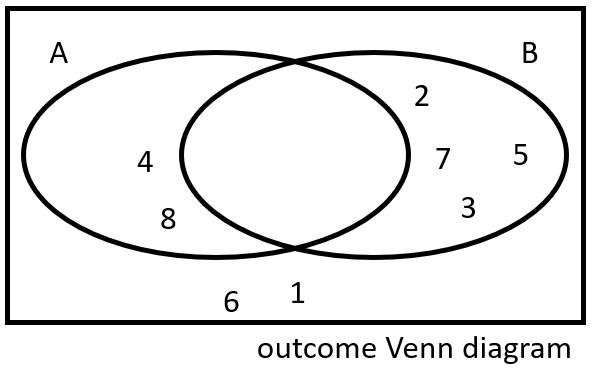
Events A and B are exhaustive.
Correct answer: Events A and B are not exhaustive.
Events A and B are not exhaustive.
Correct answer: The outcome 1 isn’t in either event A or event B.
The outcome 1 isn’t in either event A or event B.
Correct answer: Events A and B are mutually exclusive.
Events A and B are mutually exclusive.
Events A and B are not mutually exclusive.
Q4.Sam plays a video game that can either be won or lost.
The probability that Sam wins the video game is 56%.
The probability that Sam loses the video game is %.
Sam plays a video game that can either be won or lost.
The probability that Sam wins the video game is 56%.
The probability that Sam loses the video game is %.
Correct Answer: 44
44
Q5.This table shows the mutually exclusive and exhaustive set of outcomes, and the probability of each outcome, from spinning a spinner once.
The value of $$x$$ is .
This table shows the mutually exclusive and exhaustive set of outcomes, and the probability of each outcome, from spinning a spinner once.
The value of $$x$$ is .

Correct Answer: 0.3
0.3
Q6.This table shows the set of outcomes and the probability of each outcome, from spinning a spinner once.
The spinner is spun 1000 times. How many times should you expect the spinner to land on C?
This table shows the set of outcomes and the probability of each outcome, from spinning a spinner once.
The spinner is spun 1000 times. How many times should you expect the spinner to land on C?
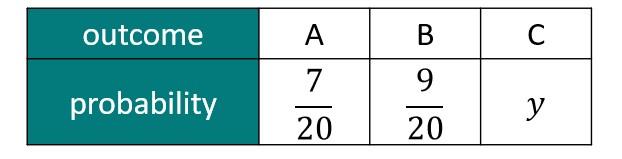
Correct Answer: 200, 200 times
200, 200 times
