Chromatography
I can describe how chromatography works and use a chromatogram to answer questions about a substance.


- Year 7
Chromatography
I can describe how chromatography works and use a chromatogram to answer questions about a substance.
Lesson details
Key learning points
- Chromatography can be used for both separation of minute samples and analysis.
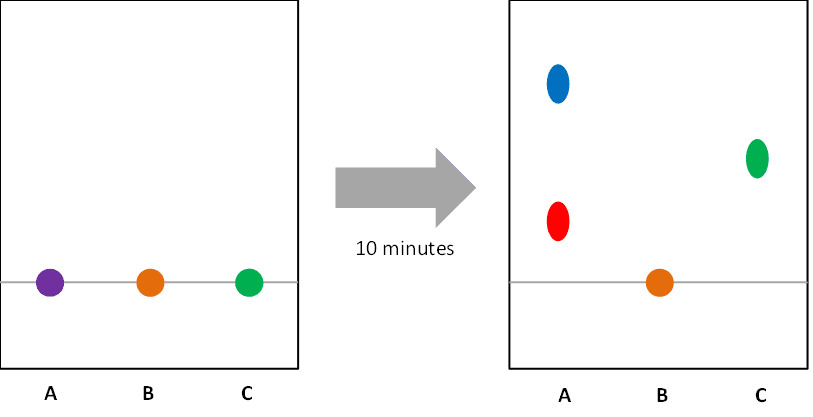
- A pure substance will only produce one spot on a chromatogram.
- A mixture will produce many spots on a chromatogram.
- Comparing chromatograms can help to identify an unknown component in a sample.
- Pencil is insoluble in water.
Keywords
Solvent - A solvent is a liquid into which a solute dissolves.
Soluble - When a substance dissolves in a liquid, it is described as soluble in that liquid.
Chromatography - Chromatography is a technique that separates a mixture into its different parts and the results can be analysed.
Chromatogram - A chromatogram is the resultant pattern on the stationary phase after chromatography has been carried out.
Compare - To compare is to look for similarities and/or differences between two objects or ideas.
Common misconception
Pupils can struggle to interpret information that contain several samples on one chromatogram.
Stress a systematic approach to interpreting chromatograms - use rulers. Live model this - using a visualiser helps enormously.


Equipment

Content guidance
- Risk assessment required - equipment

Supervision
Adult supervision required

Licence
Lesson video
Loading...
Prior knowledge starter quiz
6 Questions
Q1.If you have a mixture of sand and salt, adding water will dissolve the salt. What will happen to the sand?
Q2.A substance that dissolves in a solvent is said to be in that solvent.
Q3.Match the word with the definition.

Q4.Order the following steps describing how to make a solution.
Q5.Oil and water are two liquids that cannot mix. They are said to be ...
Q6.Which of the following substances are mixtures?
Assessment exit quiz
6 Questions
Q1.What is chromatography used for?
Q2.The pattern of results obtained from chromatography is called a ...
Q3.How does a pure substance behave in chromatography?
Q4.The line on the chromatogram on which the samples are placed must be drawn in pencil because it is in the solvent.
Q5.Order these steps in performing chromatography, starting with drawing a pencil line.
Q6.What can you conclude from this chromatogram?