New
New
Classification and reclassification: genetic evidence
I can describe the classification, and sometimes reclassification, of organisms based on evidence from their gene sequences.


Lesson 4 of 4
New
New
- Year 11
- Edexcel
Classification and reclassification: genetic evidence
I can describe the classification, and sometimes reclassification, of organisms based on evidence from their gene sequences.
Lesson details
Key learning points
- Organisms can now be classified using evidence from sequencing their genes
- Comparing gene sequences provides evidence of evolutionary relationships
- Sometimes organisms are reclassified into a different group if new evidence is discovered
Keywords
DNA - Deoxyribonucleic acid is a chemical that carries genetic information, and it is the molecule of inheritance.
Gene sequence - the sequence of DNA that codes for a particular protein
Evolutionary trees - diagrams that show the evolutionary relationships between organisms
Common misconception
Organisms evolve over a short period of time.
Draw pupils attention to the tome scales on the evolutionary trees to show that evolution takes place slowly over long periods of time.
Make sure that the class have printed versions of the gene sequence data.

Teacher tip

Equipment
highlighting pens

Licence
This content is © Oak National Academy Limited (2026), licensed on Open Government Licence version 3.0 except where otherwise stated. See Oak's terms & conditions (Collection 2).
Lesson video
Loading...
Prior knowledge starter quiz
6 Questions
Q1.Which classification group would contain the most organisms?
Which classification group would contain the most organisms?
species
kingdom
family
class
Q2.Match the names of the three domains to the organisms that are classified into them.
Match the names of the three domains to the organisms that are classified into them.

Q3.What is the primary characteristic that distinguishes eukaryotic cells from prokaryotic cells?
What is the primary characteristic that distinguishes eukaryotic cells from prokaryotic cells?
cell membrane
cytoplasm
cell wall
Q4.What major advancement did Carl Woese contribute to the field of classification?
What major advancement did Carl Woese contribute to the field of classification?
introduction of the binomial naming system
discovery of the structure of DNA
formulation of the theory of evolution
Q5.What are the three domains proposed by Carl Woese in his classification system?
What are the three domains proposed by Carl Woese in his classification system?
animals
protists
Q6.How did Linnaeus classify organisms in his classification system?
How did Linnaeus classify organisms in his classification system?
based on genetic similarity and differences
based on their ecological niche
Assessment exit quiz
6 Questions
Q1.The model shown in the diagram is an evolutionary ...
The model shown in the diagram is an evolutionary ...
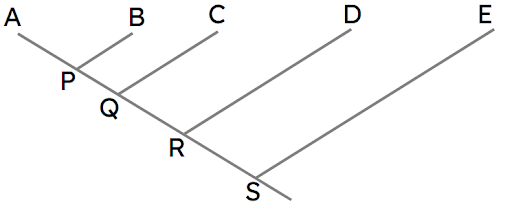
Q2.According to this evolutionary tree, which two organisms are most closely related?
According to this evolutionary tree, which two organisms are most closely related?
B and C
C and D
D and E
Q3.Which branching point, P, Q, R or S, shows the most recent common ancestor of species A, B, and C?
Which branching point, P, Q, R or S, shows the most recent common ancestor of species A, B, and C?
P
R
S
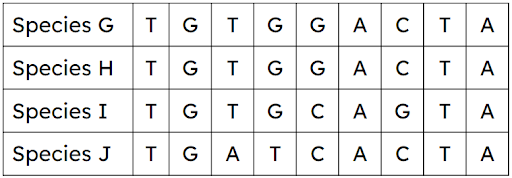
Q4.Which species is most closely related to species G?
Which species is most closely related to species G?
I
J
Q5.How many differences are there between the gene sequence of species G and that of species J?
How many differences are there between the gene sequence of species G and that of species J?
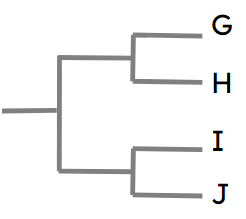
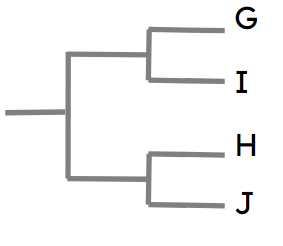
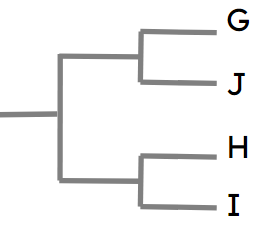
Q6.Which evolutionary tree shows the relationship between the species shown in the table?
Which evolutionary tree shows the relationship between the species shown in the table?