


New
New
Common structures of prokaryotic cells
I can identify common structures of prokaryotic cells and explain their features.


Lesson 7 of 7
New
New
- Year 10
- OCR
Common structures of prokaryotic cells
I can identify common structures of prokaryotic cells and explain their features.
Lesson details
Key learning points
- Bacteria are prokaryotic organisms.
- Common features of prokaryotic cells include the cell membrane, cytoplasm and cell wall.
- Prokaryotic cells do not have a nucleus; they store their genetic material in the cell cytoplasm.
- The genetic material is stored in one looped chromosome.
- Extra genetic material can be stored in small loops called plasmids.
Keywords
Prokaryotic - A type of cell with no membrane bound nucleus; DNA is free floating in the cytoplasm.
Plasmid - Small ring of DNA found in the cytoplasm of prokaryotic cells.
Binary fission - The form of cell division that bacteria use to replicate.
Eukaryotic - A type of cell that contains a membrane bound nucleus; the DNA is usually found inside.
Common misconception
All bacterial cells looks like the bacterial cell model.
Bacteria can come in different shapes and sizes, this will be outlined within the slide deck.
Emphasise that bacteria are unicellular, each individual rod shape is one organism.

Teacher tip

Licence
This content is © Oak National Academy Limited (2026), licensed on Open Government Licence version 3.0 except where otherwise stated. See Oak's terms & conditions (Collection 2).
Lesson video
Loading...
Prior knowledge starter quiz
6 Questions
Q1.What is the name of the substance that carries the genetic information in cells?
What is the name of the substance that carries the genetic information in cells?
ATP
glucose
oxygen
Q2.Which sub-cellular structure is not present in this bacterial cell?
Which sub-cellular structure is not present in this bacterial cell?
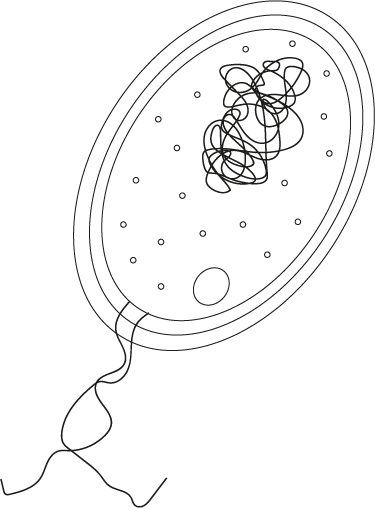
ribosomes
cell membrane
cytoplasm
Q3.What is a unicellular organism?
What is a unicellular organism?
An organism made up of many cells.
A cell with only one function.
An organism with only one nucleus.
Q4.What is the correct symbol for micrometres?
What is the correct symbol for micrometres?
mm
m
nm
Q5.What is the function of the cell wall in many cells?
What is the function of the cell wall in many cells?
The cell wall allows substances to enter and exit the cell.
The cell wall is where many chemical reactions take place.
The cell wall controls the activities of the cell.
Q6.Which cell is not eukaryotic?
Which cell is not eukaryotic?
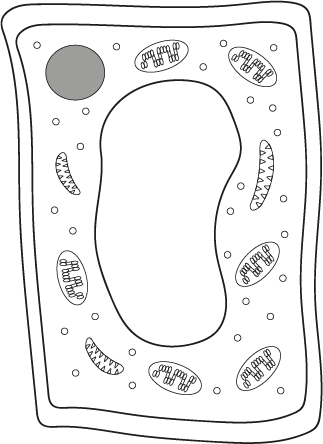
plant cell
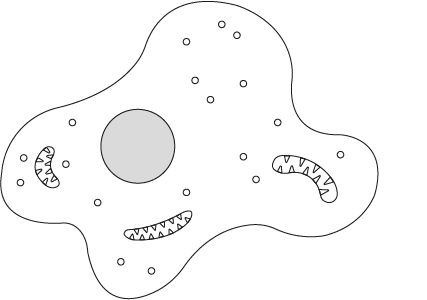
animal cell
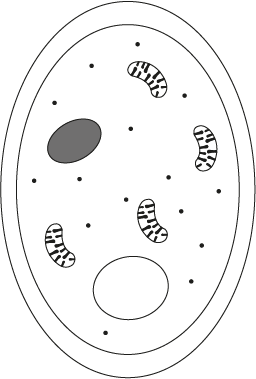
yeast cell
Assessment exit quiz
6 Questions
Q1.Which of the following would you usually find in a prokaryotic cell?
Which of the following would you usually find in a prokaryotic cell?
chloroplasts
mitochondria
nucleus
Q2.Where is the DNA found in prokaryotic cells?
Where is the DNA found in prokaryotic cells?
nucleus
cell wall
flagellum
Q3.Bacterial cell walls are usually made up of which substance?
Bacterial cell walls are usually made up of which substance?
cellulose
amylase
glycogen
Q4.What is the process by which bacterial cells divide?
What is the process by which bacterial cells divide?
mitosis
meiosis
photosynthesis
Q5.Match the term to its correct definition.
Match the term to its correct definition.

Q6.Which statements below are true?
Which statements below are true?
During binary fission, the DNA splits in half.
Prokaryotic cells are usually more complex than eukaryotic cells.
