


Conditional probability in a Venn diagram
I can calculate a conditional probability from a Venn diagram.


- Year 11
Conditional probability in a Venn diagram
I can calculate a conditional probability from a Venn diagram.
Lesson details
Key learning points
- A Venn diagram can be used to calculate conditional probabilities
- A Venn diagram can be used to calculate conditional probabilities involving sets of events
- Venn diagrams allow us to identify which events are mutually exclusive
- Venn diagrams can be used to identify which events are independent
Keywords
Venn diagram - Venn diagrams are a representation used to model statistical/probability questions. Commonly circles are used to represent events.
Probability - The probability that an event will occur is the proportion of times the event is expected to happen in a suitably large experiment.
Conditional probability - Conditional probability is the probability of an outcome occurring given that another event has occurred.
Independent events - Event A is independent of event B if the probability of event A occurring is not affected by whether or not event B occurs.
Mutually exclusive - Mutually exclusive events have no outcomes in common.
Common misconception
Pupils may confuse the probability of event A given B, P(A|B), with the probability of event A and B occurring.
Use the context of the question to make a judgement about what probability is to be calculated. Try to avoid using, or draw attention to, potentially ambiguous language/notation. E.g. Is P(AB) referring to P(A given B) or P(B given A) or P(A and B)?


Licence
Lesson video
Loading...
Prior knowledge starter quiz
6 Questions
Q1.Event A is of event B if the probability of event A occurring is not affected by whether or not event B occurs.

Q2.Select the example of events which are not independent.
Q3.The table shows the types of marble in a bag. Match each event to its probability.
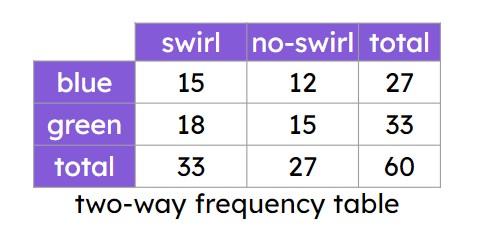
P(blue) - $$27\over 60$$
P(green) - $$33\over 60$$
P(blue and has no swirl) - $$12\over 60$$
P(blue given it has no swirl) - $$12\over 27$$
P(green and has a swirl) - $$18\over60$$
P(green given it has swirl) - $$18\over 33$$
Q4.A marble is taken at random from a box of marbles. Alex works out that P(swirl given it is blue) = P(swirl). This shows the event 'has a swirl' is __________ of the event 'blue marble'.
Q5.A 10-sided die with integers from 1 to 10 written on it is rolled once. Select the pair of mutually exclusive events.
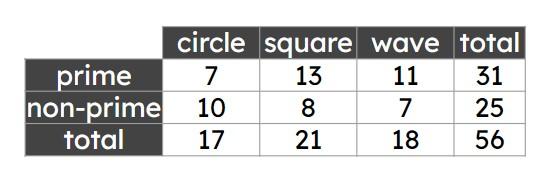
Q6.A deck of cards has a number on it (either prime or non-prime), and a symbol (a circle, square, or wave). A card is selected at random from the deck. Find P(non-prime | wave).
Assessment exit quiz
6 Questions
Q1.Event A and event B are mutually exclusive events. Which of these statements are correct?
Q2.From the frequency Venn diagram, P(A | B) = . Give your answer as a decimal.
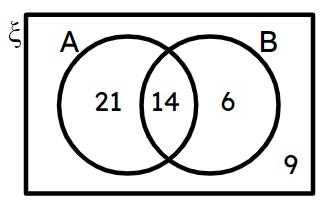
Q3.From the frequency Venn diagram, P(A | B') = . Give your answer as a decimal.
Q4.The diagram shows the number of outcomes for two events A and B. The values of P(A | B) and P(A | B') show that events A and B are events.
Q5.Here is an incomplete frequency Venn diagram. P(C) = $$1\over3$$, P(D') = $$1\over6$$, P(C ∩ D) = $$1 \over 4$$ and P(C | D) = $$3 \over 10$$. The value of $$x$$ is .
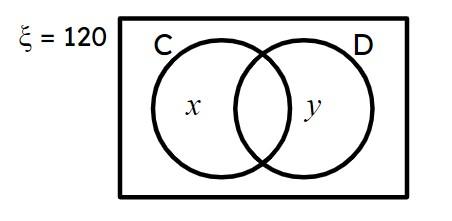
Q6.Here is an incomplete frequency Venn diagram. P(C) = $$1\over3$$, P(D') = $$1\over6$$, P(C ∩ D) = $$1 \over 4$$ and P(C | D) = $$3 \over 10$$. The value of $$y$$ is .
