


Different speeds (v=s/t)
I can describe how to calculate average speed, instantaneous speed and relative speed and estimate the speed of everyday things.


- Year 10
- AQA
Different speeds (v=s/t)
I can describe how to calculate average speed, instantaneous speed and relative speed and estimate the speed of everyday things.
Lesson details
Key learning points
- Average speed = distance / time.
- The speed of sound in air is about 330 m/s.
- Scalar quantities have magnitude only.
- Speed and distance are scalar quantities.
- Relative speed is the speed an object is moving towards or away from another object, which may also be moving.
Keywords
Average speed - The average speed of an object is the distance it travels each second (m/s). It is a scalar quantity.
Instantaneous speed - The instantaneous speed of an object is the speed at a particular moment.
Scalar quantity - Some quantities only have magnitude (size), and not direction. This includes distance and speed.
Magnitude - A scalar quantity only has magnitude (size).
Relative speed - The relative speed of objects is the difference in their speeds taking into account direction of movement.
Common misconception
Pupils often do not have an understanding of what moving at a particular speed means in the real world, and treat answers as ‘just numbers’.
Use real world examples of speeds through examples and questions asked (N.B. 10 m/s is approximately 20 miles per hour).


Content guidance
- Depiction or discussion of sensitive content

Supervision
Adult supervision recommended

Licence
Lesson video
Loading...
Prior knowledge starter quiz
6 Questions
Q1.Members of a running group compared their times to complete a park run.
Use the times to put the runners in order of decreasing speed, starting with the fastest.
Q2.Which of the following is not a valid unit for speed?
Q3.Match the activity to the typical speed for that activity.

Q4.Two cyclists are racing up a hill. Cyclist A has a speed of 20 m/s and cyclist B travels 48 metres in 3 seconds.
If the cyclists continue to travel at these same speeds, which statement is correct?

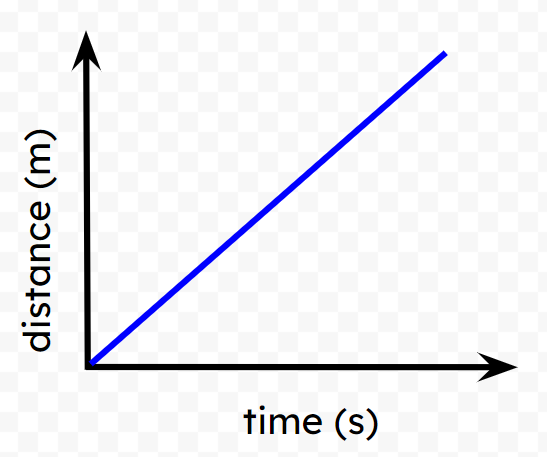
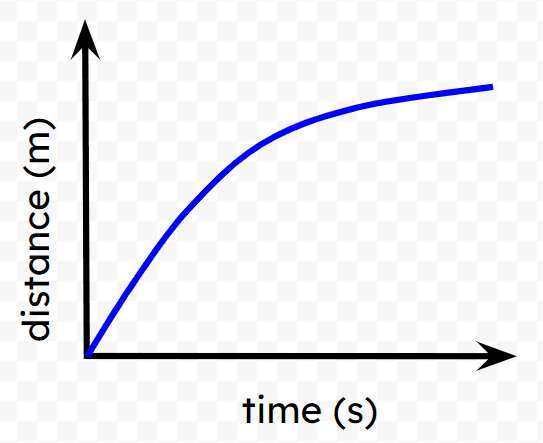
Q5.Which of these distance–time graphs shows the motion of a stationary object?


Q6.The motion of two cars, A and B, has been displayed on a distance–time graph.
Which statement about the two cars is correct?

Assessment exit quiz
6 Questions
Q1.Match the key words or phrases to their definitions.
Q2.Match the activity to the typical speed for that activity.
