


New
New
Different surfaces: do and review
I can carry out tests and compare how things move on different surfaces.


Lesson 2 of 12
New
New
- Year 3
Different surfaces: do and review
I can carry out tests and compare how things move on different surfaces.
Lesson details
Key learning points
- Objects move differently over different surfaces.
- Scientists can carry out comparative test investigations to compare different surfaces.
- Friction forces slow down moving objects.
- A rough surface will create a greater friction force against a moving object than a smooth surface.
- In a conclusion, scientists explain what the results show or mean.
Keywords
Surface - The surface is the top or outside layer of something.
Friction forces - Friction forces are forces which act between the surfaces of objects.
Rough - Rough surfaces are uneven or bumpy.
Smooth - Smooth surfaces are even and not bumpy.
Conclusion - In a conclusion, scientists explain what the results show or mean.
Common misconception
Friction doesn’t have a direction; a force is needed to keep an object moving at a constant speed.
Provide examples, with images, to demonstrate the effects of friction on moving objects.
This lesson should link directly to the previous lesson in this unit (Lesson 1) whereby children planned how they are going to find answers to the question: Does the surface a marble rolls on affect how far the marble moves?

Teacher tip

Equipment
See additional information for further support and guidance.

Content guidance
- Risk assessment required - equipment
- Exploration of objects

Supervision
Adult supervision required

Licence
This content is © Oak National Academy Limited (2026), licensed on Open Government Licence version 3.0 except where otherwise stated. See Oak's terms & conditions (Collection 2).
Lesson video
Loading...
Prior knowledge starter quiz
6 Questions
Q1.What is a surface?
What is a surface?
The middle layer of something.
The inside of something.
Q2.Which of the following statements are true about surfaces?
Which of the following statements are true about surfaces?
They are 2-D (2-dimensional).
They are only 3-D (3-dimensional).
Q3.Starting with the smoothest, order these surfaces from smoothest to roughest.
Starting with the smoothest, order these surfaces from smoothest to roughest.
Q4.You should only one thing in a comparative test investigation.
You should only one thing in a comparative test investigation.
Q5.Match the enquiry type to the correct example.
Match the enquiry type to the correct example.

Q6.Which of these parts of an investigation explain what the results show or mean?
Which of these parts of an investigation explain what the results show or mean?
the question
the list of equipment
Assessment exit quiz
6 Questions
Q1.Moving objects slow down or travel less far due to forces.
Moving objects slow down or travel less far due to forces.
Q2.Friction forces act between the of objects.
Friction forces act between the of objects.
Q3.Starting with polished ceramic tile, order these objects from the surface which creates the weakest friction forces to the surface that creates the greatest friction forces.
Starting with polished ceramic tile, order these objects from the surface which creates the weakest friction forces to the surface that creates the greatest friction forces.
Q4.If a ball rolls over two different surfaces, it will move more slowly on the surface which creates the friction force.
If a ball rolls over two different surfaces, it will move more slowly on the surface which creates the friction force.
Q5.What would you find in a conclusion?
What would you find in a conclusion?
a record of observations
a prediction
a plan for an investigation
Q6.Which is the correct conclusion from this enquiry question and set of results?
Which is the correct conclusion from this enquiry question and set of results?
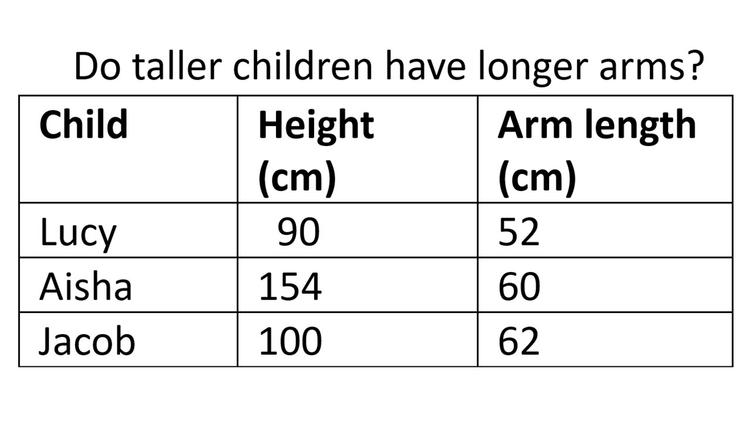
The results show that taller children have longer arms.
The results show that taller children have shorter arms.
