


New
New
Identify knowns and unknowns in addition equations
I can identify knowns and unknowns in addition equations.


Lesson 4 of 10
New
New
- Year 3
Identify knowns and unknowns in addition equations
I can identify knowns and unknowns in addition equations.
Lesson details
Key learning points
- If the sum is missing, you add the addends.
- If an addend is missing, subtract the other addend from the sum to calculate the missing value.
- When the numbers are close together, add on to find the difference.
Keywords
Addend - An addend is a number added to another.
Sum - The sum is the the total when numbers are added together.
Difference - The difference is the result after subtracting one number from another.
Common misconception
Pupils may confuse the parts and the whole in an equation, especially when there is a missing number.
Bar models are helpful for representing and understanding the parts and the whole. Ensure that pupils understand that minuend and sum both represent a whole. Allow lots of opportunities for pupils to sketch bar models.
Base ten blocks may be helpful for pupils when subtracting. Number lines representations may also be helpful, especially for comparing the relative size of numbers and understanding whether they are close together or far apart.

Teacher tip

Licence
This content is © Oak National Academy Limited (2025), licensed on Open Government Licence version 3.0 except where otherwise stated. See Oak's terms & conditions (Collection 2).
Lesson video
Loading...
Prior knowledge starter quiz
6 Questions
Q1.Which number in this equation is the sum? 100 = 20 + 80
Which number in this equation is the sum? 100 = 20 + 80
80
20
Q2.Which of these are parts in an equation?
Which of these are parts in an equation?
sum
minuend
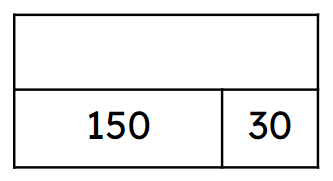
Q3.What is the missing sum in this bar model?
What is the missing sum in this bar model?
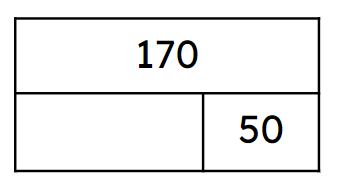
Q4.What is the value of the missing part in this bar model?
What is the value of the missing part in this bar model?
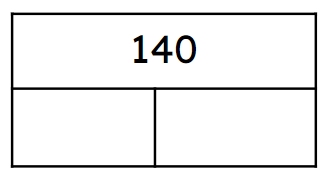
Q5.What could the missing addends in this bar model be?
What could the missing addends in this bar model be?
80 and 40
110 and 40
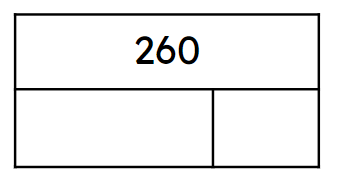
Q6.Which equations could be represented by the bar model?
Which equations could be represented by the bar model?
260 + 40 = 300
260 = 360 − 100
Assessment exit quiz
6 Questions
Q1.Which number represents the difference in this equation? 25 − 15 = 10
Which number represents the difference in this equation? 25 − 15 = 10
25
15
Q2.Match the keywords to their meanings.
Match the keywords to their meanings.

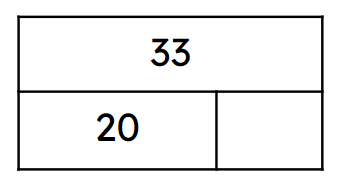
Q3.What is the missing part in this bar model?
What is the missing part in this bar model?
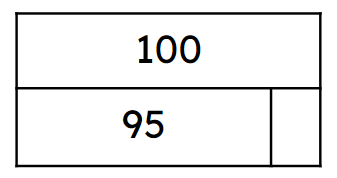
Q4.What is the value of the missing part in this bar model?
What is the value of the missing part in this bar model?
Q5.Which pairs of numbers have a difference of 3?
Which pairs of numbers have a difference of 3?
22 and 24
28 and 30
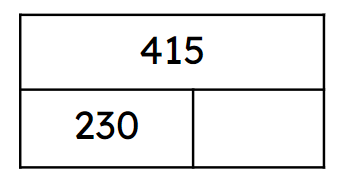
Q6.How could you calculate the missing part in this bar model?
How could you calculate the missing part in this bar model?
415 + 230 =
230 − 415 =
