


New
New
Measure volume in whole litres and millilitres
I can measure volume in whole litres and millilitres.


Lesson 6 of 10
New
New
- Year 3
Measure volume in whole litres and millilitres
I can measure volume in whole litres and millilitres.
Lesson details
Key learning points
- Scales are marked in different ways and counting in 10s, 20s, 50s and 25s helps to read scales.
- The volume of larger amounts of liquids can be measured in whole litres and millilitres.
- There are 1,000 ml in 1 L.
- We can use our knowledge of 1 L and 1,000 ml to determine the volume of liquids.
Keywords
Volume - The volume is the amount of space that an object takes up. In this case, the specific amount of liquid in a container.
Millilitre - The millilitre is a metric measure of capacity or volume. It is a very small amount of liquid. One teaspoon can hold 5 ml of water.
Litre - The litre is a metric measure of capacity or volume. A litre is made up of 1,000 ml.
Common misconception
Children further learn about the composition of 1,000 in Y4, so may make mistakes in reading scales.
Rehearse 1,000 is composed of two equal parts of 500 ml, four equal parts of 250 ml, five equal parts of 200 ml, 10 equal parts of 100 ml.
Make the lesson as practical as possible. Physically show the children the difference between 1 ml and 1 L so they grasp the difference in amount. Support children to become confident with measuring larger amounts of liquids over 1 L.

Teacher tip

Licence
This content is © Oak National Academy Limited (2025), licensed on Open Government Licence version 3.0 except where otherwise stated. See Oak's terms & conditions (Collection 2).
Lesson video
Loading...
Prior knowledge starter quiz
6 Questions
Q1.Which of these units could the volume of liquid in a bottle be measured in?
Which of these units could the volume of liquid in a bottle be measured in?
g
cm
kg
Q2.Look at the bar model. 100 is composed of four equal parts of .
Look at the bar model. 100 is composed of four equal parts of .

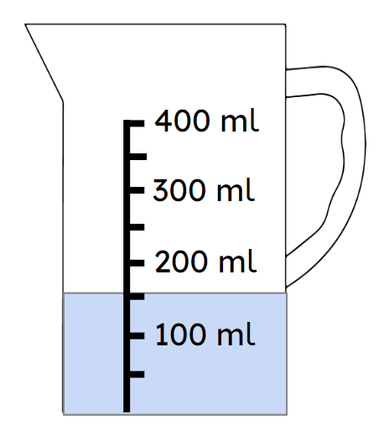
Q3.Look at the jug. Match the 'capacity of the jug' and 'volume of water in the jug' to their measurement.
Look at the jug. Match the 'capacity of the jug' and 'volume of water in the jug' to their measurement.

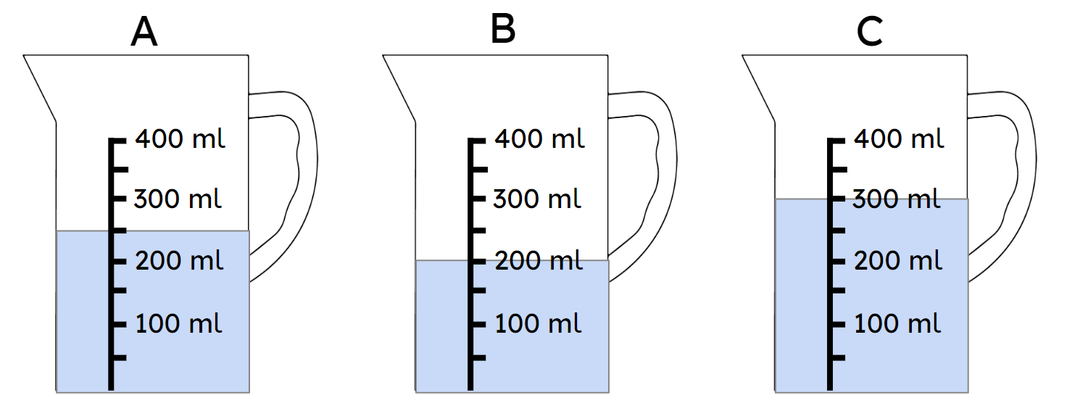
Q4.Starting with the jug with the smallest volume of water, put these jugs in order of the water that they contain.
Starting with the jug with the smallest volume of water, put these jugs in order of the water that they contain.
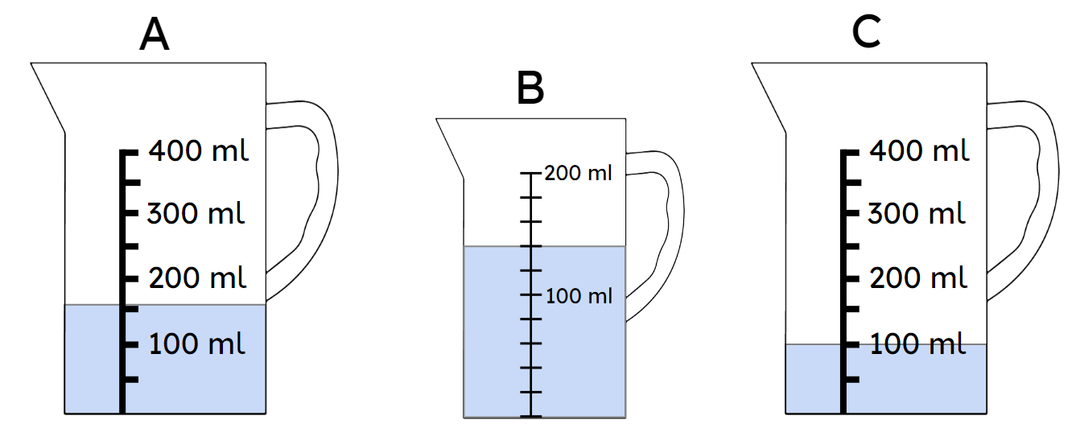
Q5.Which jug contains the greatest volume of water?
Which jug contains the greatest volume of water?
B
C
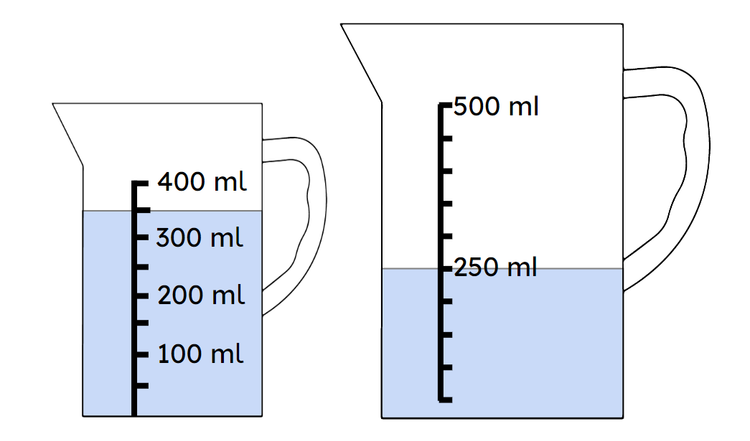
Q6.Look at these jugs. What is the total volume of water in the two jugs?
Look at these jugs. What is the total volume of water in the two jugs?
100 ml
550 ml
560 ml
Assessment exit quiz
6 Questions
Q1.One litre is equivalent to millilitres.
One litre is equivalent to millilitres.
1
10
100
Q2.True or False? A volume of 200 ml is greater than a volume of 2 L?
True or False? A volume of 200 ml is greater than a volume of 2 L?
True
Q3.What is the volume of water in this jug?
What is the volume of water in this jug?
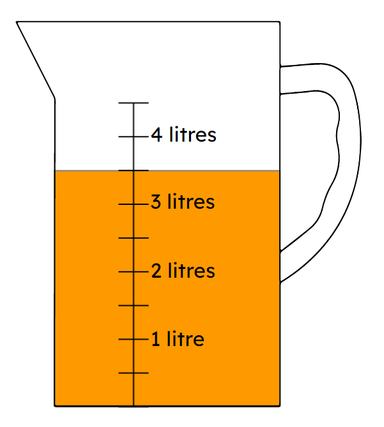
3 L 100 ml
3 L 200 ml
3 L 250 ml
Q4.Match the jug to the volume of water that it contains.
Match the jug to the volume of water that it contains.
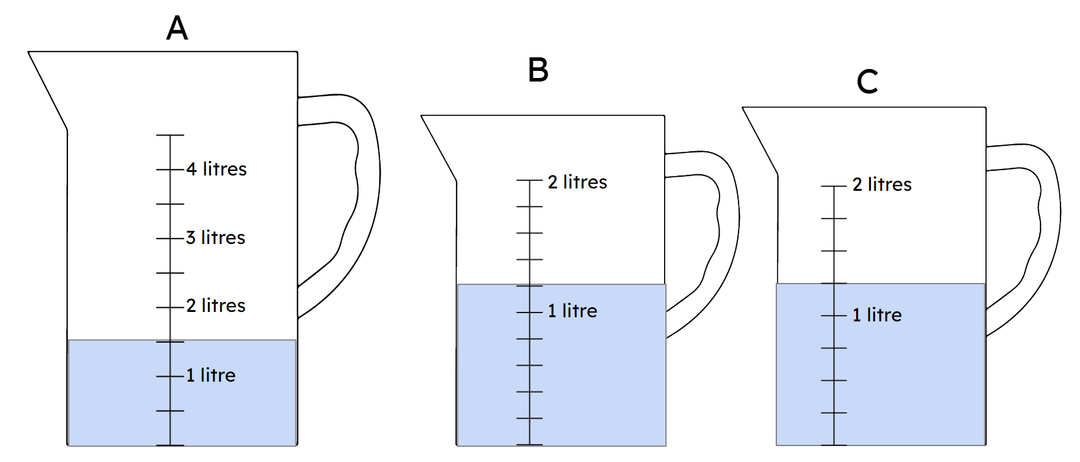
Q5.How much more water does Jug B contain than Jug A?
How much more water does Jug B contain than Jug A?
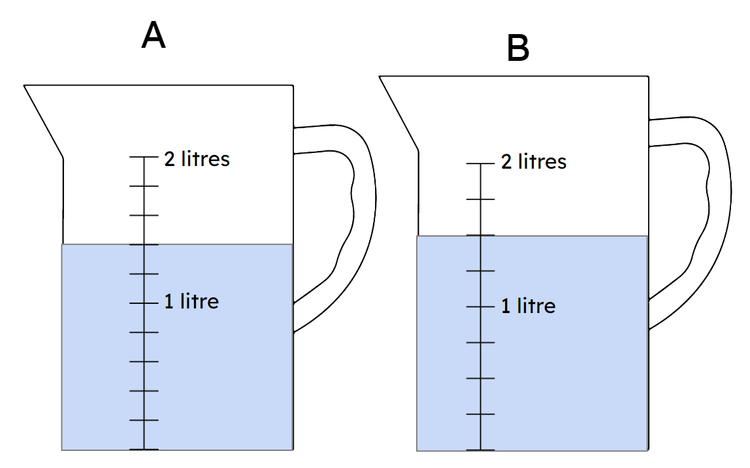
50 ml
200 ml
They both contain the same volume of liquid.
Q6.Look at the volume of water in this jug. What volume of water needs to be added so that the jug is full to capacity?
Look at the volume of water in this jug. What volume of water needs to be added so that the jug is full to capacity?
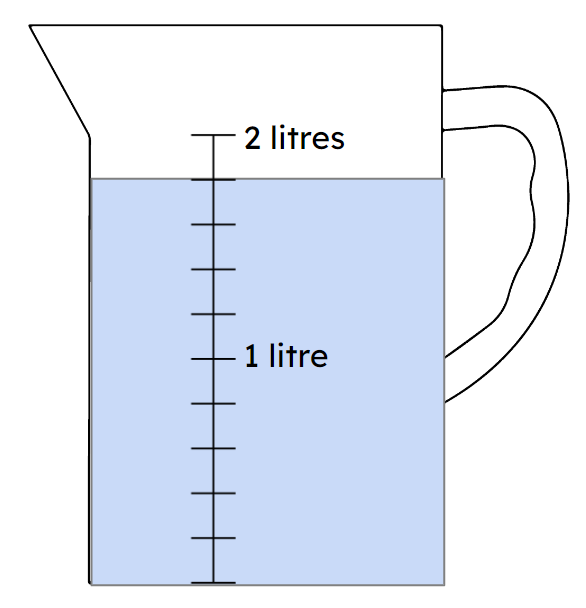
100 ml
250 ml
500 ml
