Measuring the resistance of a diode
I can interpret an I–V graph of a diode in order to describe its properties.

Measuring the resistance of a diode
I can interpret an I–V graph of a diode in order to describe its properties.
Lesson details
Key learning points
- The properties of a diode are different, depending on the direction of p.d. across it.
- An appropriate range of p.d. includes 0 V and the maximum voltage of the diode and at least four other readings.
- An appropriate range for a diode includes the maximum p.d. in both directions, with positive and negative values.
- For electricity investigations, it is good practice to take many more than the minimum number of measurements.
Keywords
Diode - an electrical component that is used to prevent current flow in one direction
Semiconductor - a material that has both metallic and non-metallic properties
Threshold p.d. - the potential difference at which a diode allows current to flow
Reverse–biased - when a diode is reverse–biased, it prevents current from flowing
Forward–biased - when a diode is forward–biased, it allows current to flow
Common misconception
The gradient of an I–V graph is equal to 1/R because I = V ÷ R.
Explain how the equation for a straight line graph y = mx + c does not apply in this case because the graph is not a straight line.


Equipment
diodes, milliammeters, voltmeters, variable resistors, 100 kiloohm resistors, electrical leads

Content guidance
- Risk assessment required - equipment

Supervision
Adult supervision required

Licence
Lesson video
Loading...
Prior knowledge starter quiz
6 Questions
Q1.What happens when free electrons in a metal collide with metal ions?

Q2.What causes free electrons in a metal to move?
Q3.Which of the following effects will result from a higher p.d. across a metal wire in a working electrical circuit?
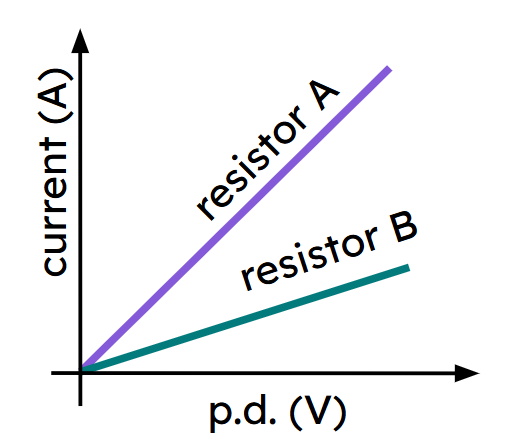
Q4.Which of the followings statements about resistors A and B is correct?
Q5.Which of the following elements is a semiconductor?
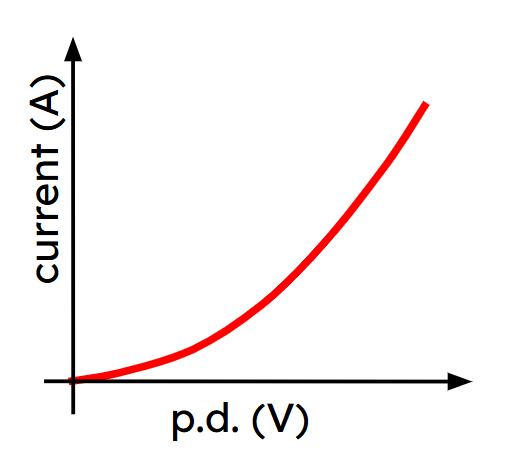
Q6.Which of the following statements about the I–V graph shown is correct?
Assessment exit quiz
6 Questions
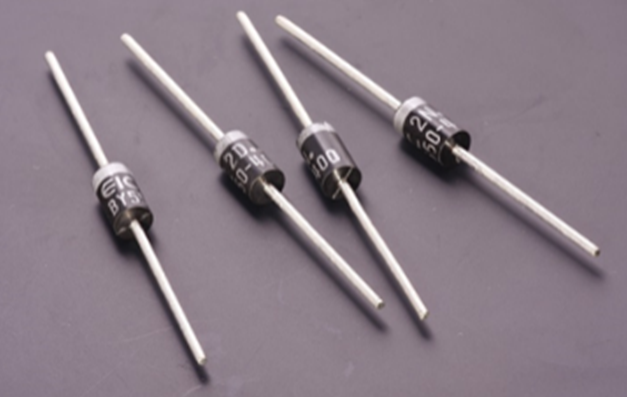
Q1.Which of the following components are shown in the image?