New
New

    Measuring waves on a string

    I can find the speed of waves on a string by measuring ‘standing wave’ patterns.

    New
    New

      Measuring waves on a string

      I can find the speed of waves on a string by measuring ‘standing wave’ patterns.

      Lesson details

      Key learning points

      1. To find standing wave frequencies, increase the frequency of the oscillator until a standing wave pattern is seen.
      2. The wavelength of the waves can be found from the length of the oscillating string and the standing wave pattern
      3. The speed of waves on a string only depends on the properties of the wave medium (the string).
      4. For waves on a string, frequency and wavelength are inversely proportional
      5. Control variables are the quantities that must be kept the same during experiments so they don’t affect results.

      Keywords

      • Standing wave - A standing wave is a stable pattern of oscillation that does not appear to travel across a wave medium.

      • Tension - Tension is the name for the force applied to a stretched string or rope. Without any tension a string or rope would be slack.

      • Inverse - Division is the mathematical inverse (opposite) of multiplication, so the inverse of ×2 is ÷2 (which can also be written as ×½).

      • Proportion - A proportion is an exact mathematical comparison, such as double, half (50%), triple, a third, quadruple, a quarter etc.

      • Control variable - Control variables are the quantities that must be kept the same during experiments so they don’t affect results.

      Common misconception

      Frequency or wavelength of waves on a string will affect the wave speed.

      The speed of waves on a string only depends on the properties of the wave medium (the string) e.g. tension, density

      There is an example video of data being collected but it would be far better for students to see this 'live' in class and play an active role in collecting the measurements.
      Teacher tip

      Content guidance

      • Risk assessment required - equipment

      Supervision

      Adult supervision required

      Licence

      This content is © Oak National Academy Limited (2026), licensed on Open Government Licence version 3.0 except where otherwise stated. See Oak's terms & conditions (Collection 2).

      Lesson video

      Loading...

      Prior knowledge starter quiz

      Download quiz pdf

      6 Questions

      Q1.
      Waves on a string are waves.

      Correct answer: transverse
      longitudinal
      electromagnetic

      Q2.
      What is 12 cm in metres?

      0.012 m
      Correct answer: 0.12 m
      1.20 m
      12 m
      12 000 m

      Q3.
      Some waves on a string have a frequency of 3 Hz and a wavelength of 12 cm. How would you calculate the wave speed in m/s?

      3 x 12
      Correct answer: 3 x 0.12
      3 ÷ 12
      3 ÷ 0.12
      0.12 ÷ 3

      Q4.
      In experiments, what are the different types of variables?

      Correct Answer:independent variable,what you change in each test to see what effect it has

      what you change in each test to see what effect it has

      Correct Answer:dependent variable,what you monitor to see if it changes in response

      what you monitor to see if it changes in response

      Correct Answer:control variables,what you keep the same so they don't affect the results

      what you keep the same so they don't affect the results

      Q5.
      When a wave travels along a string, what is the wave medium?

      the middle point of a wave, halfway along a wavelength
      the frequency of the wave
      Correct answer: the string
      the equilibrium position

      Q6.
      If waves of different frequencies and wavelengths all have the same speed, what happens if you increase the frequency of waves?

      increasing the frequency also increases the wavelength
      Correct answer: increasing the frequency decreases the wavelength
      increasing the frequency does not affect the wavelength

      Assessment exit quiz

      Download quiz pdf

      6 Questions

      Q1.
      In an experiment, a variable that must be kept the same so it does not affect the results, is called a variable.

      Correct Answer: control, controlled, Control

      Q2.
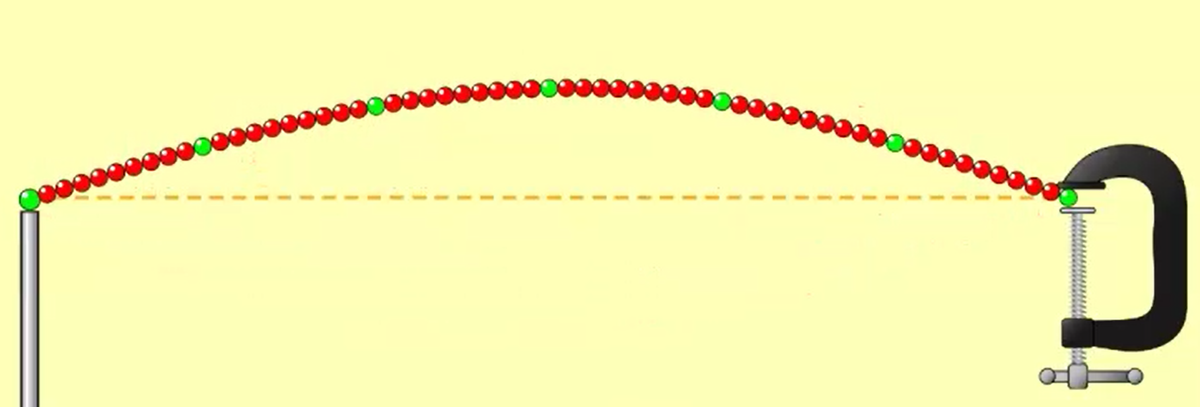
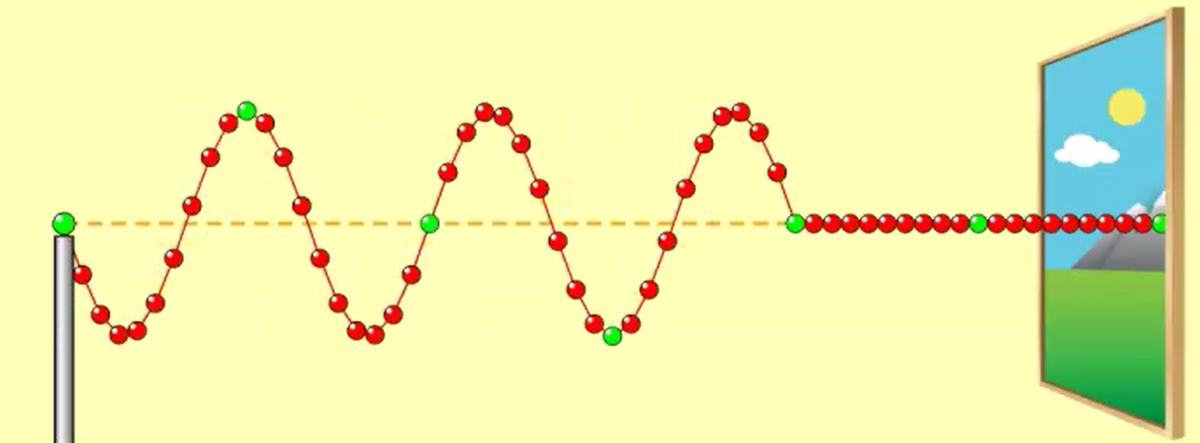
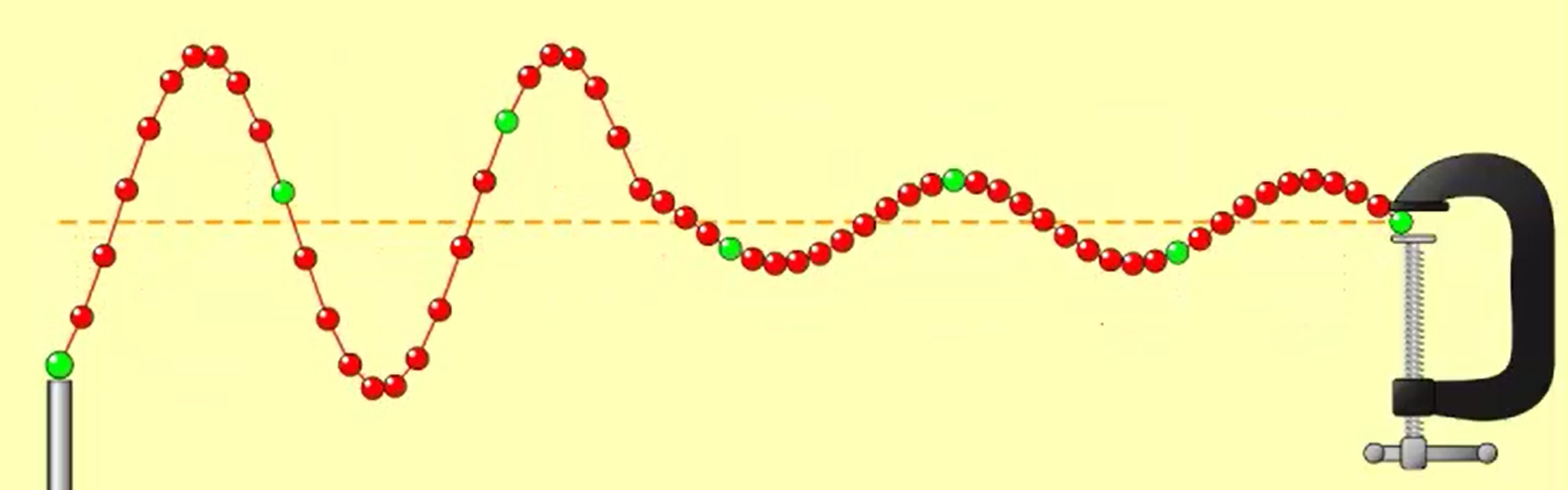
      Which images show a standing wave on a string?
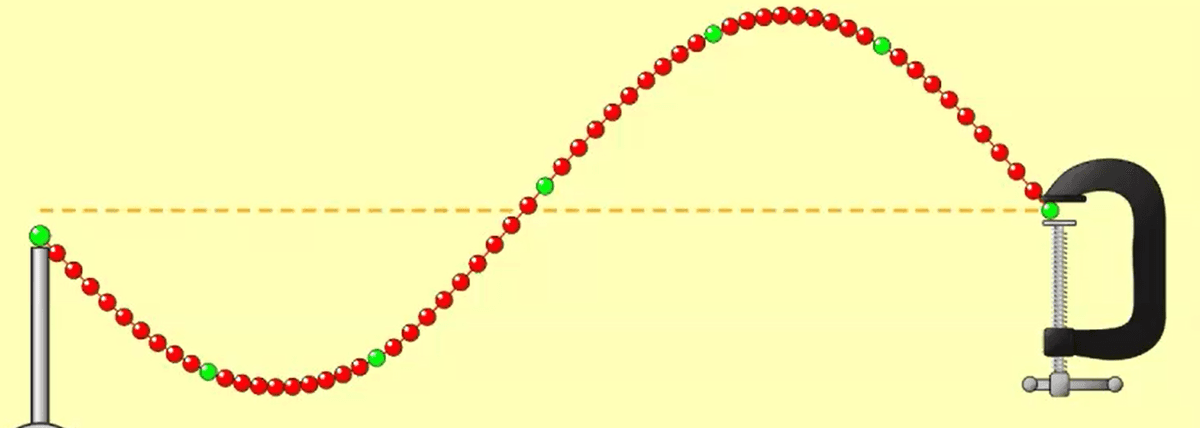
      Correct Answer: An image in a quiz
      An image in a quiz
      Correct Answer: An image in a quiz
      An image in a quiz
      An image in a quiz
      An image in a quiz

      Q3.
      The length of string oscillating in this image is 90 cm. What is the wavelength of the waves?
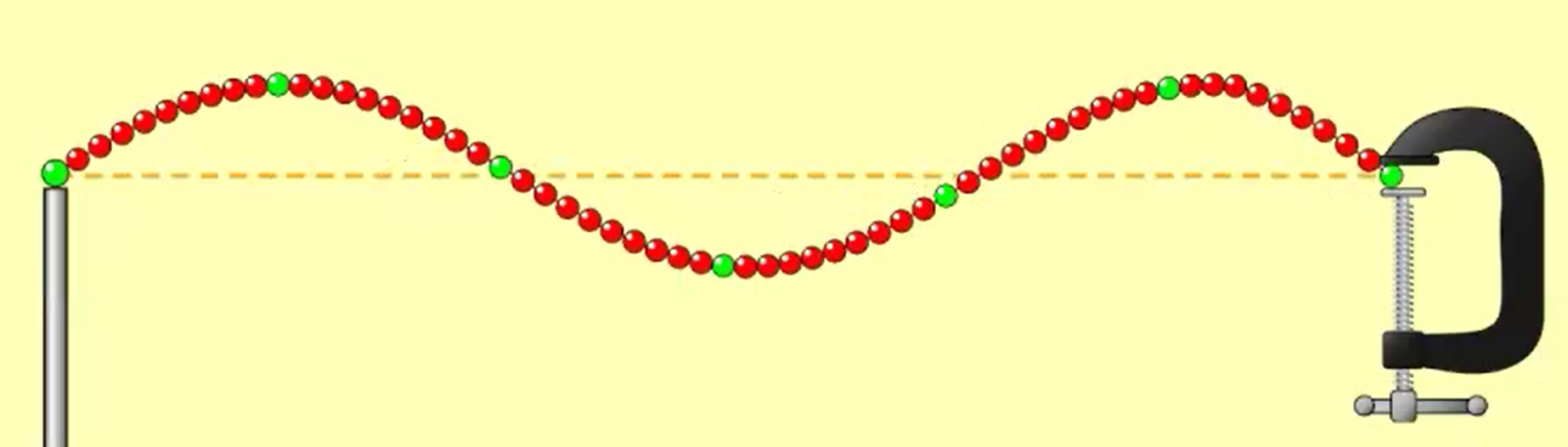
      An image in a quiz
      30 cm
      Correct answer: 60 cm
      90 cm
      180 cm

      Q4.
      Starting with the measurement of the string length, put the steps in order to find the speed of waves on a string from a standing wave pattern.

      1 - Measure the length of the string using a metre rule.
      2 - Slowly increase the frequency of the oscillator until a standing wave is seen.
      3 - Record the frequency from the signal generator and work out the wavelength.
      4 - Calculate the wave speed using speed = frequency x wavelength.

      Q5.
      Suggest which of the following could affect the speed of waves on a string?

      The frequency of the waves
      The wavelength of the waves
      The amplitude of the waves
      Correct answer: The tension of the string
      Correct answer: The density of the string

      Q6.
      Waves on a string have a frequency of 10 Hz and a wavelength of 20 cm. The frequency is increased from 10 Hz to 40 Hz. Nothing else changed. How would the wavelength be affected?

      Correct answer: The wavelength would reduce from 20 cm to 5 cm
      The wavelength would reduce from 20 cm to 10 cm
      The wavelength would stay the same
      The wavelength would increase from 20cm to 40 cm
      The wavelength would increase from 20 cm to 80 cm
      Q2 image 1 Simulation by PhET Interactive Simulations, University of Colorado Boulder, licensed under CC-BY-4.0 (https://phet.colorado.edu). Q2 image 2 Simulation by PhET Interactive Simulations, University of Colorado Boulder, licensed under CC-BY-4.0 (https://phet.colorado.edu). Q2 image 3 Simulation by PhET Interactive Simulations, University of Colorado Boulder, licensed under CC-BY-4.0 (https://phet.colorado.edu). Q2 image 4 Simulation by PhET Interactive Simulations, University of Colorado Boulder, licensed under CC-BY-4.0 (https://phet.colorado.edu). Q3 Simulation by PhET Interactive Simulations, University of Colorado Boulder, licensed under CC-BY-4.0 (https://phet.colorado.edu).

      Lesson appears in

      UnitCombined science / Measuring waves