New
New
Multiply a 2-digit number by a 1-digit number using short multiplication (regrouping 1s to 10s)
I can use short multiplication to record regrouping from the 1s to the 10s.


Lesson 7 of 10
New
New
- Year 5
Multiply a 2-digit number by a 1-digit number using short multiplication (regrouping 1s to 10s)
I can use short multiplication to record regrouping from the 1s to the 10s.
Lesson details
Key learning points
- If the product of the ones digit is greater than 10, you regroup ten ones into one ten.
- Record the additional ten or tens as a small digit to be added in with the tens.
- Short multiplication results in only one product being recorded.
- There are similarities and differences between the expanded recording and short multiplication.
Keywords
Short multiplication - A method using columns to set out and calculate a multiplication is short multiplication.
Regrouping - The process of unitising and exchanging between place values is known as regrouping.
Common misconception
Pupils may not align or regroup correctly leading to an inaccurate calculation.
Ask children about the additional ten or tens as a small digit to be added in with the tens. What does this show? What is the value?
Ensure pupils can generalise short multiplication results in only one product being recorded. Allow lots of opportunities for pupils to practise the layout and set up of the strategy.

Teacher tip

Licence
This content is © Oak National Academy Limited (2025), licensed on Open Government Licence version 3.0 except where otherwise stated. See Oak's terms & conditions (Collection 2).
Lesson video
Loading...
Prior knowledge starter quiz
6 Questions
Q1.Jacob is chanting his 7 times tables: 7, 14, 21, 28, ___ What comes next?
Jacob is chanting his 7 times tables: 7, 14, 21, 28, ___ What comes next?
34

42
43
Q2.Aisha is chanting her 9 times tables: 9, 18, 27, What comes next?
Aisha is chanting her 9 times tables: 9, 18, 27, What comes next?
Q3.Look at the multiplication equation: 82 × 2. When multiplying in the ones column this will give us a ___ digit partial product.
Look at the multiplication equation: 82 × 2. When multiplying in the ones column this will give us a ___ digit partial product.
2
3
Q4.Use short multiplication to calculate this question: 42 × 2 =
Use short multiplication to calculate this question: 42 × 2 =
Q5.Calculate and sort the multiplication equations into descending order.
Calculate and sort the multiplication equations into descending order.
Q6.The product is 2 digits. 3 and 11 are two of my many factors. This number is also a multiple of 9. What number could it be?
The product is 2 digits. 3 and 11 are two of my many factors. This number is also a multiple of 9. What number could it be?
Assessment exit quiz
6 Questions
Q1. The answer when two or more values are multiplied together is known as the __________.
The answer when two or more values are multiplied together is known as the __________.
factor
partial product
addend
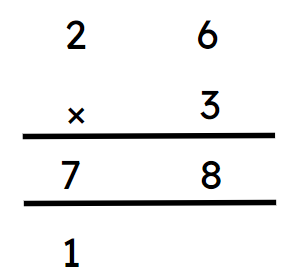
Q2.Complete the sentence 3 × 6 ones is 18 ones. 18 is made up of 1 ten and 8 ones. I will regroup 1 ten and place it underneath the column.
Complete the sentence 3 × 6 ones is 18 ones. 18 is made up of 1 ten and 8 ones. I will regroup 1 ten and place it underneath the column.
ones column
hundreds column
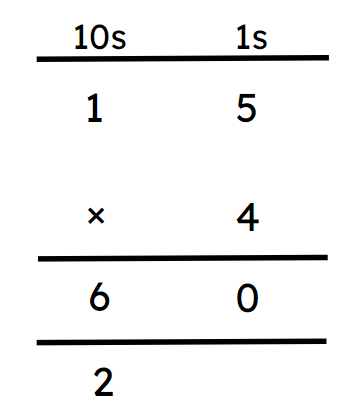
Q3.I have regrouped tens.
I have regrouped tens.
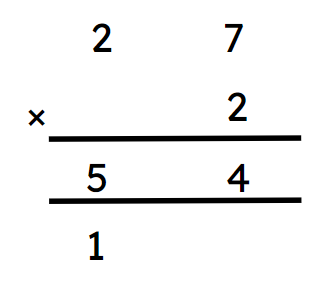
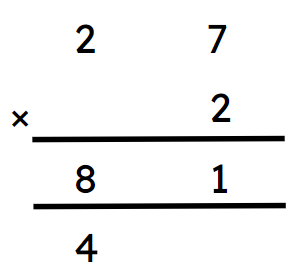
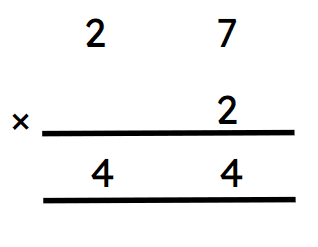
Q4.The multiplication is: 27 × 2 Which short multiplication shows this correctly?
The multiplication is: 27 × 2 Which short multiplication shows this correctly?
picture 2
picture 3
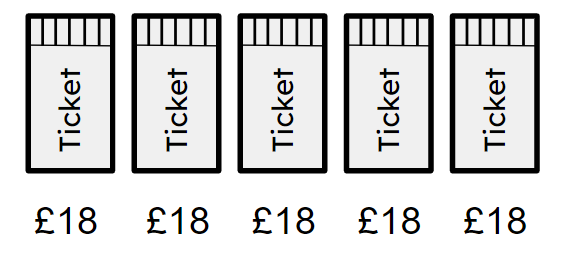
Q5.One ticket costs £18. How much would Lucas’s tickets costs altogether? Remember to use correct notation in your answer.
One ticket costs £18. How much would Lucas’s tickets costs altogether? Remember to use correct notation in your answer.
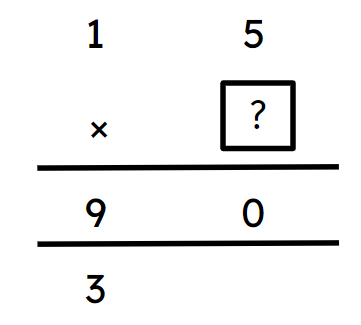
Q6.What is the missing factor?
What is the missing factor?