


New
New
Outliers in scatter graphs
I can recognise outliers and understand whether they should be included in the data set.


Lesson 5 of 8
New
New
- Year 10
Outliers in scatter graphs
I can recognise outliers and understand whether they should be included in the data set.
Lesson details
Key learning points
- Outliers can be visually seen on a scatter graph.
- Outliers do not necessarily occur at the start/end of the data set.
- Outliers must be carefully considered and only removed if they were recorded in error.
Keywords
Outlier - An outlier is a data point that is extremely large or small compared to the rest of the dataset. Visually, outliers lie far away from where the majority of the results are clustered.
Common misconception
An outlier always has values that are outside the range of the dataset (i.e. at the start or end of a dataset).
For bivariate data, a data point may be distinct from the rest of the data because the value of one of its variable is extremely less/greater than other points that have a similar value in its other variable.
Pupils could explore any previous scatter graphs they have seen (which may not necessarily have any outliers). They could discuss where a hypothetical outlier could be plotted on the graph, why it would be an outlier and how it would be interpreted in the context of its data.

Teacher tip

Licence
This content is © Oak National Academy Limited (2025), licensed on Open Government Licence version 3.0 except where otherwise stated. See Oak's terms & conditions (Collection 2).
Lesson video
Loading...
Prior knowledge starter quiz
6 Questions
Q1.Extrapolation is when you estimate values that are the range of available data
Extrapolation is when you estimate values that are the range of available data
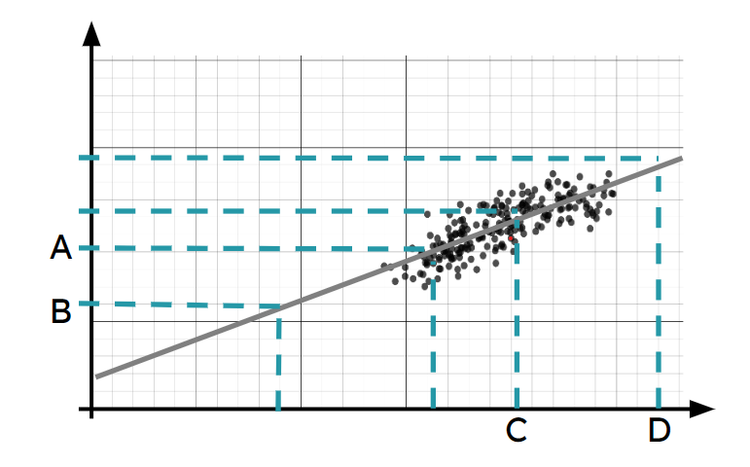
Q2.Which values are obtained by interpolation on this scatter diagram?
Which values are obtained by interpolation on this scatter diagram?
B
D
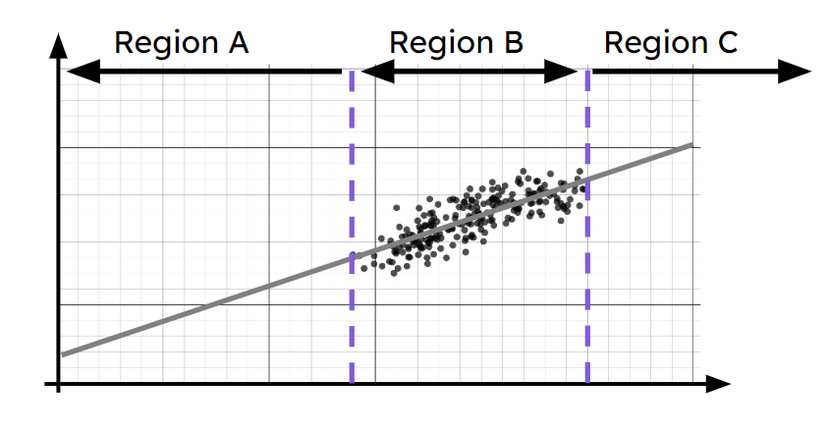
Q3.Select the regions where extrapolation can be used to make estimations on this scatter graph.
Select the regions where extrapolation can be used to make estimations on this scatter graph.
A only
B only
C only
B and C
Q4.Alex says, “I can always use interpolation to make a valid prediction when my bivariate data has correlation.” Is Alex definitely correct?
Alex says, “I can always use interpolation to make a valid prediction when my bivariate data has correlation.” Is Alex definitely correct?
No, interpolation is always completely unreliable.
No, it has to be used with caution as the trend might not continue.
Yes, interpolation is always completely reliable.
Q5.The scatter graph shows data taken from the ONS, where each point represents a region in England and Wales in 2023. Select which of these Oak pupils can use this graph to make an accurate prediction.
The scatter graph shows data taken from the ONS, where each point represents a region in England and Wales in 2023. Select which of these Oak pupils can use this graph to make an accurate prediction.
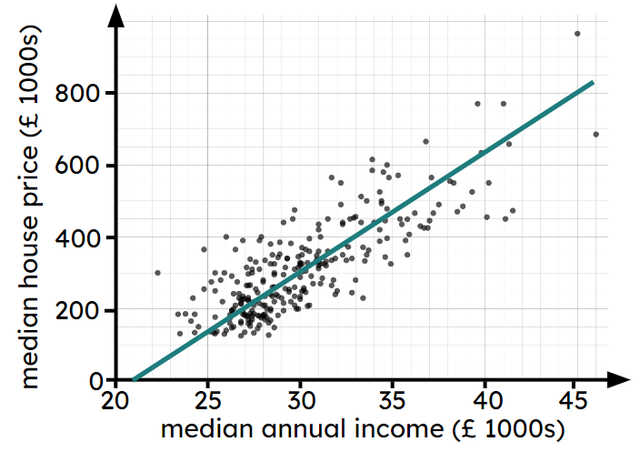
Laura: I want the house price in Oakford where the median income is £19 000
Jacob: I want the house price in Spain where the median income is £35 000
Sam: I want the house price in Elmway where the median income is £92 000
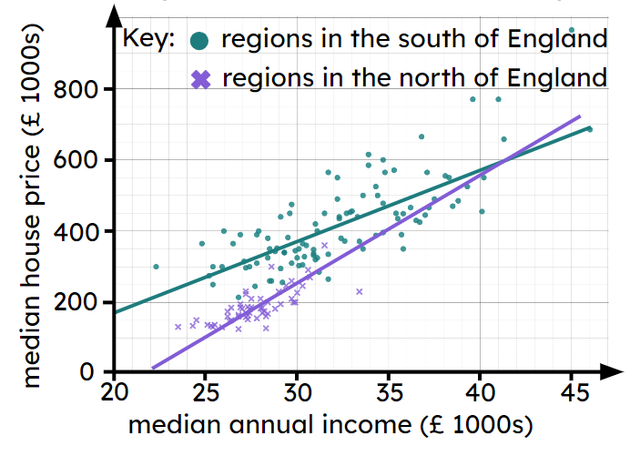
Q6.The scatter graphs shows information about house prices and income in different regions. Estimate the difference between the house prices in the North and South for a median income of £25 000
The scatter graphs shows information about house prices and income in different regions. Estimate the difference between the house prices in the North and South for a median income of £25 000
£100 000
£125 000
£250 000
£375 000
Assessment exit quiz
6 Questions
Q1.An is a data point that is extremely large or small compared to the rest of the dataset.
An is a data point that is extremely large or small compared to the rest of the dataset.
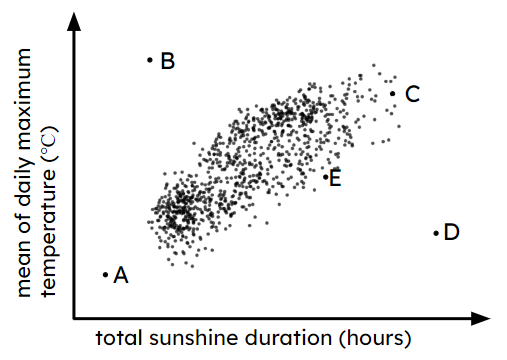
Q2.Which of these points are an outlier?
Which of these points are an outlier?
C
E
Q3.Sam says that it is possible to have a dataset with no outliers. Is Sam correct?
Sam says that it is possible to have a dataset with no outliers. Is Sam correct?
No, all datasets will have a highest value.
No, there will always be a datapoint that is lower than the rest.
No, not all the data points will cluster.
Yes, not every dataset has errors in it.
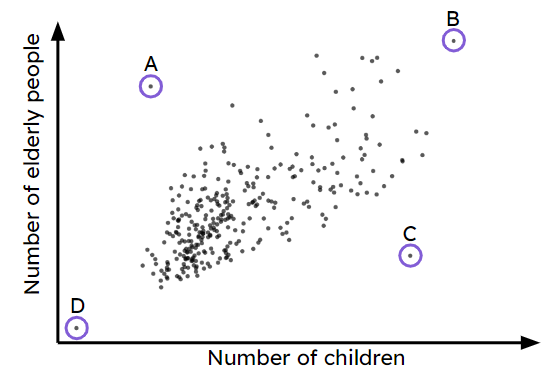
Q4.The scatter graph shows information about number of children and number of elderly people in a set of towns. Each point represents a town. Match each outlier to the correct statement.
The scatter graph shows information about number of children and number of elderly people in a set of towns. Each point represents a town. Match each outlier to the correct statement.

Q5.Sofia says you should never ignore an outlier. Is Sofia correct?
Sofia says you should never ignore an outlier. Is Sofia correct?
No, if a data point is extremely large then it must be an error.
Yes, an outlier is always just an unusual result in the data.
Q6.Jacob says you should show the outlier on a scatter graph. Is Jacob correct?
Jacob says you should show the outlier on a scatter graph. Is Jacob correct?
No, outliers are always too far from the rest of the data to show.
Yes, otherwise the scatter graph is wrong.
