


Parallel linear graphs
I can identify, from their equations or graphs, whether two lines are parallel.


- Year 10
Parallel linear graphs
I can identify, from their equations or graphs, whether two lines are parallel.
Lesson details
Key learning points
- Two lines are parallel if they are equidistant and never touch.
- For linear graphs, the rate of change is constant.
- If the gradients are the same then the linear graphs may be parallel.
- The y-intercepts must be different, otherwise the lines are the same.
Keywords
Gradient - The gradient is a measure of how steep a line is. It is calculated by finding the rate of change in the y-direction with respect to the positive x-direction.
Intercept - An intercept is the coordinate where a line or curve meets a given axis.
Parallel - Two lines are parallel if they are straight lines that are always the same (non-zero) distance apart.
Common misconception
Lines are parallel if they have the same gradient.
Lines are parallel if they have the same gradient and different y-intercepts. Two lines are parallel if they are straight lines that are always the same non-zero distance apart.


Licence
Lesson video
Loading...
Prior knowledge starter quiz
6 Questions
Q1.Which of these best completes the definition of parallel: 'Two lines are parallel if they are straight lines which...'?

Q2.Match the equation of each straight line to its gradient.
$$y = 5x + 6$$ - gradient is 5
$$y = 6x + 3$$ - gradient is 6
$$y = 3 - 5x$$ - gradient is -5
$$y = -(6 + 3x)$$ - gradient is -3
$$y + 6x = 5$$ - gradient is -6
$$2y = 6x + 5$$ - gradient is 3
Q3.The gradient of the line shown on this graph is .
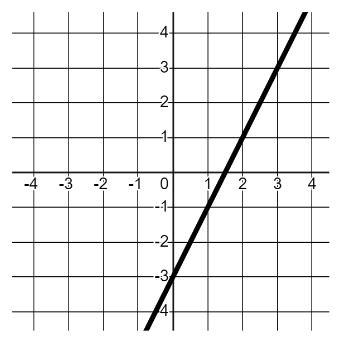
Q4.Which of these coordinates are on the line $$y = -x - 5$$ ?
Q5.What is the gradient of the line with equation $$3y + 4x - 8 = 0$$ ?
Q6.A line passes through the points with coordinates (-3, 4) and (5, -12). The gradient of this line is .
Assessment exit quiz
6 Questions
Q1.Five lines have been drawn on the same graph. Which of these lines is parallel to line A (black)?
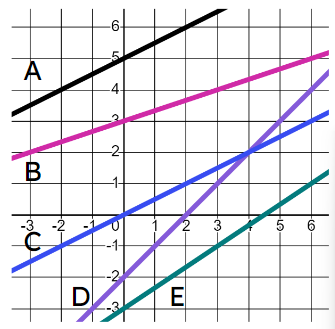
Q2.Match each equation of a line to an equation of a line that is parallel to it.
$$y = x + 4$$ - $$y = x + 100$$
$$ y = 2x - 3$$ - $$ y = 2x + 0.5$$
$$ y = 3 - x $$ - $$ y = -x + {5\over 2}$$
$$ y = 3x - 1$$ - $$ y = 4 + 3x$$
$$ y = -2x + 1$$ - $$ y = 3 - 2x$$
Q3.Which of these equations will produce a line that is parallel to the line with equation $$5y - 2x = 15$$ ?
Q4.The line with equation $$y =$$ $$- 2x$$ passes through the point (1, 4) and is parallel to the line $$y = 7 - 2x$$.
Q5.Which of these is the equation of the line which goes through the point (10, 20) and is parallel to the line $$y = {5\over 2}x + 1$$?
Q6.The line L passes through the points with coordinates (3, 7) and (5, 10). Which of these lines are parallel to the line L?
