


New
New
Representing sequences graphically
I can represent arithmetic sequences graphically and appreciate the common structure.


Lesson 10 of 12
New
New
- Year 8
Representing sequences graphically
I can represent arithmetic sequences graphically and appreciate the common structure.
Lesson details
Key learning points
- The terms in a sequence can be written as coordinates.
- The coordinates can be plotted on a grid.
- Arithmetic sequences have common structures.
- Other sequences might have common structures you can investigate.
Keywords
Arithmetic sequence - An arithmetic (or linear) sequence is a sequence where the difference between successive terms is a constant.
Common misconception
When plotting sequences, a line must be drawn through the points.
Plot (1,5), (2,10), (3,15), draw a line and find other coordinates. When n = 1.5 the term value is 7.5. Is 7.5 in the sequence 5n??
Learning cycle 2 sees students looking at the structure of an arithmetic sequence using bricks made up of dots. At this stage ask them to make up a picture of their own sequence and see if they can identify each others' sequences.

Teacher tip

Licence
This content is © Oak National Academy Limited (2025), licensed on Open Government Licence version 3.0 except where otherwise stated. See Oak's terms & conditions (Collection 2).
Lesson video
Loading...
Prior knowledge starter quiz
6 Questions
Q1.An arithmetic (linear) sequence has a __________ difference.
An arithmetic (linear) sequence has a __________ difference.

Correct answer: constant
constant
variable
unknown
positive
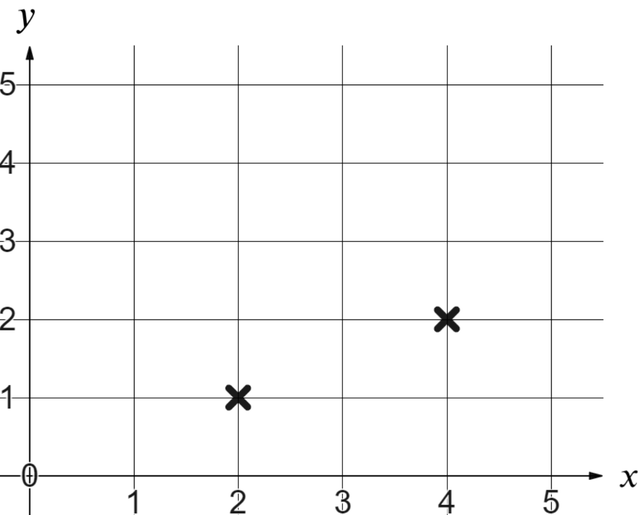
Q2.Which two pairs of coordinates are shown here?
Which two pairs of coordinates are shown here?
$$(1,2)$$ and $$(2,4)$$
$$(1,2)$$ and $$(4,2)$$
$$(2,1)$$ and $$(2,4)$$
Correct answer: $$(2,1)$$ and $$(4,2)$$
$$(2,1)$$ and $$(4,2)$$
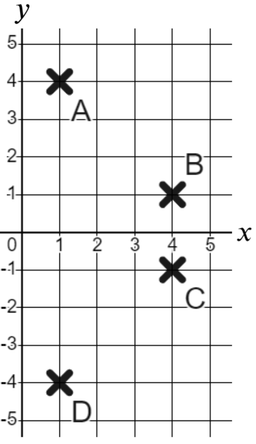
Q3.Match the letters with the correctly plotted coordinates.
Match the letters with the correctly plotted coordinates.
Correct Answer:A,$$(1,4)$$
A - $$(1,4)$$
Correct Answer:B,$$(4,1)$$
B - $$(4,1)$$
Correct Answer:C,$$(4,-1)$$
C - $$(4,-1)$$
Correct Answer:D,$$(1,-4)$$
D - $$(1,-4)$$
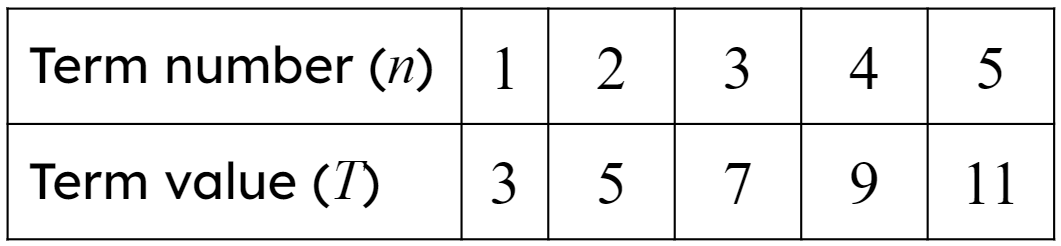
Q4.Which of these are true for this sequence?
Which of these are true for this sequence?
Correct answer: When $$n=1, T=3$$
When $$n=1, T=3$$
When $$n=5, T=2$$
Correct answer: When $$n=3, T=7$$
When $$n=3, T=7$$
When $$n=5, T=5$$
Correct answer: When $$n=5, T=11$$
When $$n=5, T=11$$
Q5.Match the sequences with the common difference.
Match the sequences with the common difference.
Correct Answer:1, 8, 15, 22, ...,+7
1, 8, 15, 22, ... - +7
Correct Answer:1, -6, -13, -20, ...,-7
1, -6, -13, -20, ... - -7
Correct Answer:36, 30, 24, 18, ...,-6
36, 30, 24, 18, ... - -6
Correct Answer:-39, -33, -27, -21, ...,+6
-39, -33, -27, -21, ... - +6
Correct Answer:0, 3, 7, 12, ...,No common difference
0, 3, 7, 12, ... - No common difference
Correct Answer:-17, -9, -1, 7, ...,+8
-17, -9, -1, 7, ... - +8
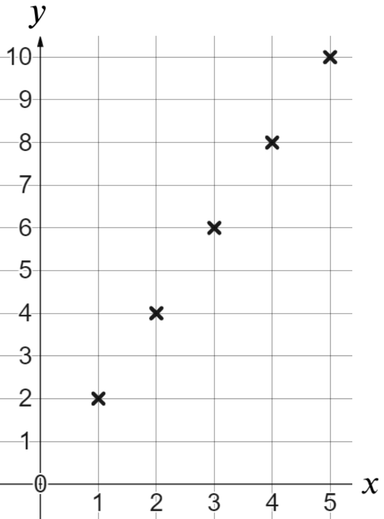
Q6.What is true of this set of coordinates?
What is true of this set of coordinates?
The $$x$$ coordinate is always double the $$y$$ coordinate.
Correct answer: The $$y$$ coordinate is always double the $$x$$ coordinate.
The $$y$$ coordinate is always double the $$x$$ coordinate.
The $$y$$ coordinate is always two more than the $$x$$ coordinate.
Correct answer: As the $$x$$ coordinate increases by 1, $$y$$ increases by 2
As the $$x$$ coordinate increases by 1, $$y$$ increases by 2
Assessment exit quiz
6 Questions
Q1.When you plot an arithmetic sequence graphically the coordinates form a straight line, hence they are also known as __________ sequences.
When you plot an arithmetic sequence graphically the coordinates form a straight line, hence they are also known as __________ sequences.
additive
Correct answer: linear
linear
straight
common difference
Q2.If you completed this table of values before plotting the arithmetic sequence $$2n-7$$ which values would you put in the 'Term value' places?
If you completed this table of values before plotting the arithmetic sequence $$2n-7$$ which values would you put in the 'Term value' places?
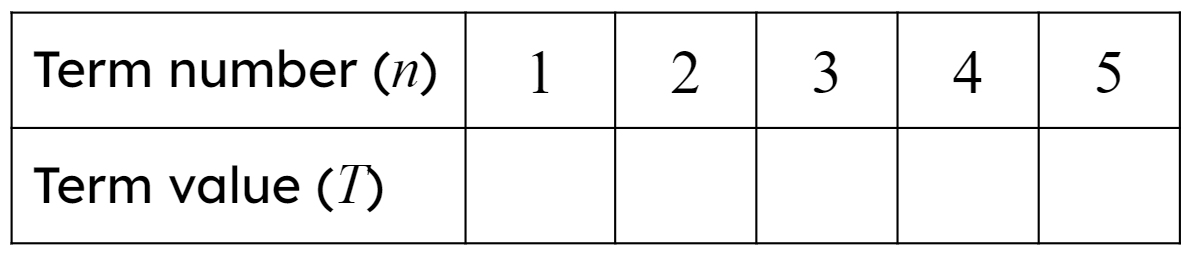
Correct answer: -5, -3, -1, 1, 3
-5, -3, -1, 1, 3
-2, 5, 12, 19, 26
-7, -5, -3, -1, 1
-7, -9, -11, -13, -15
-5, -7, -9, -11, -13
Q3.This is a table of values for the sequence $$4n-11$$. If you were going to graph this sequence which of these coordinates are correct?
This is a table of values for the sequence $$4n-11$$. If you were going to graph this sequence which of these coordinates are correct?
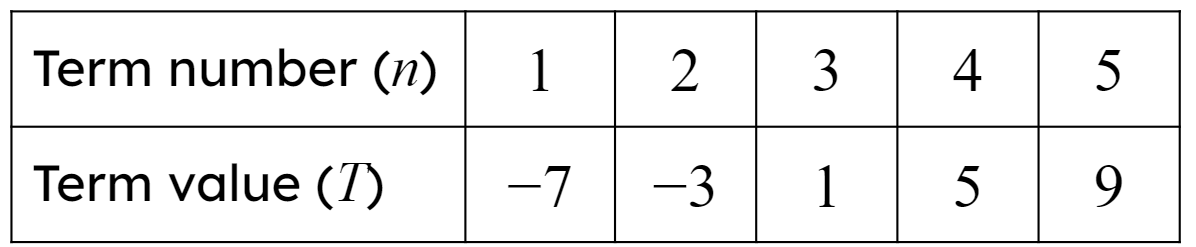
Correct answer: (2,-3)
(2,-3)
(-3,2)
Correct answer: (4,5)
(4,5)
(5,4)
Correct answer: (5,9)
(5,9)
Q4.Which sequence is represented by this graph?
Which sequence is represented by this graph?
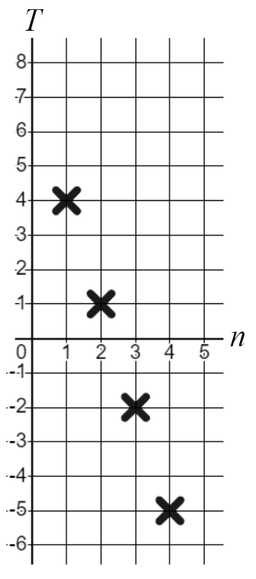
Correct answer: $$7-3n$$
$$7-3n$$
$$4-3n$$
$$3n+4$$
$$-5+3n$$
Q5.This structure represents which sequence?
This structure represents which sequence?
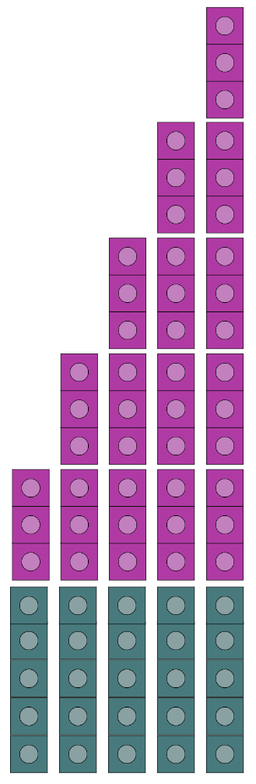
$$3+5n$$
Correct answer: $$3n+5$$
$$3n+5$$
$$(5+3)n$$
Correct answer: $$5+3n$$
$$5+3n$$
$$5n+3$$
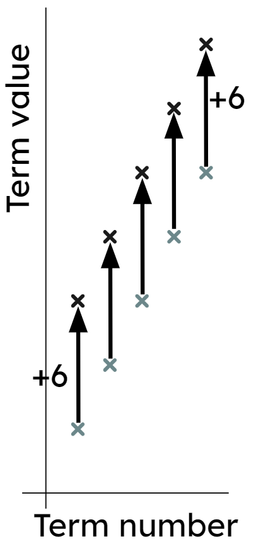
Q6.The sequence $$3n$$ is translated by +6 in the vertical direction. What sequence is now shown?
The sequence $$3n$$ is translated by +6 in the vertical direction. What sequence is now shown?
$$n+6$$
$$6n$$
$$6n+3$$
Correct answer: $$3n+6$$
$$3n+6$$
$$9n$$
