


New
New
Secure identifying a whole and the parts that make it up
I can identify a whole and the parts that make it up.


Lesson 1 of 5
New
New
- Year 4
Secure identifying a whole and the parts that make it up
I can identify a whole and the parts that make it up.
Lesson details
Key learning points
- An item can be a whole or a part depending on the situation.
- Use of ‘If the ___ is the whole, then the ___ are a part of the whole.’ supports us to identify the whole and parts.
- The whole can be different in different situations.
- A part is always smaller than the whole.
Keywords
Whole - The whole is all the parts or everything, the total amount.
Part - A part is some, but not all, of the whole.
Common misconception
Pupils might think that larger objects cannot be a part of a whole due to their size. Children may not appreciate that the same item can be a whole or a part depending on the context.
Encourage pupils to work with parts and wholes that they can handle and experience but where parts are large and have them look at example where the same object can be a whole or a part.
There are stem sentences within the lesson so encourage choral practice. Choose contexts that are relevant in your context to engage the children.

Teacher tip

Licence
This content is © Oak National Academy Limited (2025), licensed on Open Government Licence version 3.0 except where otherwise stated. See Oak's terms & conditions (Collection 2).
Lesson video
Loading...
Prior knowledge starter quiz
6 Questions
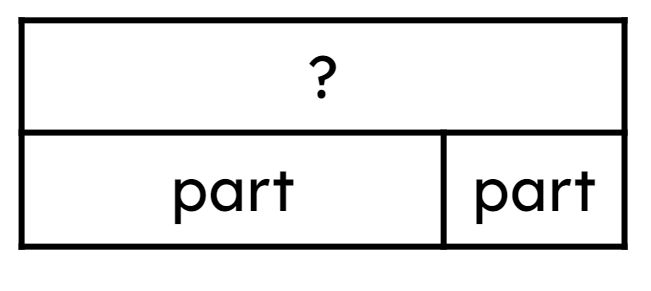
Q1.What is the missing label in this bar model?
What is the missing label in this bar model?

Q2.Choose the correct word to complete this sentence: The __________ is all the parts or everything, the total amount.
Choose the correct word to complete this sentence: The __________ is all the parts or everything, the total amount.
product
difference
hole
addend
Q3.Look at the bar model. Identify the parts.
Look at the bar model. Identify the parts.
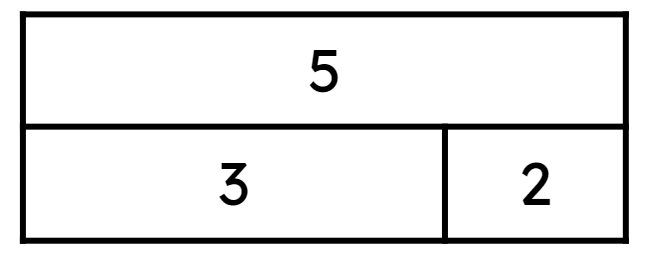
5
Q4.Look at the equation 7 + 5 = 12 Identify the whole.
Look at the equation 7 + 5 = 12 Identify the whole.
7
5
=
+
Q5.Look at the equation 5 + 7 + 3 = 15 Identify the parts.
Look at the equation 5 + 7 + 3 = 15 Identify the parts.
15
=
Q6.Order these events from a typical day, starting with the thing you do first.
Order these events from a typical day, starting with the thing you do first.
Assessment exit quiz
6 Questions
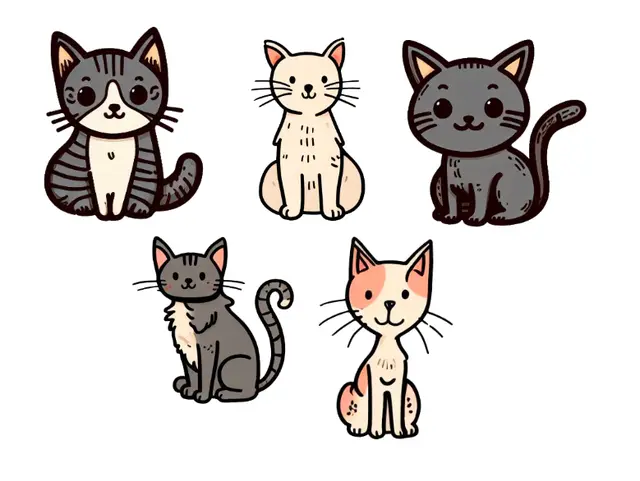
Q1.If the group of cats is the whole, then the grey cats are a of the whole.
If the group of cats is the whole, then the grey cats are a of the whole.
Q2.Parts are always __________ than their whole when you are dealing with fraction of objects.
Parts are always __________ than their whole when you are dealing with fraction of objects.
greater
bigger
wider
thinner
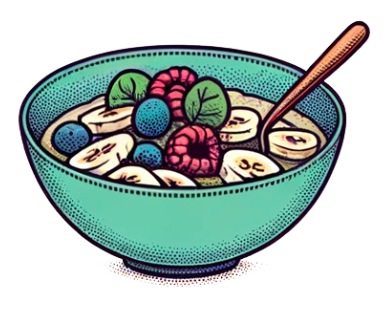
Q3.Which words could complete the sentence: if a bowl of cereal is the whole then the __________ is one part of the whole.
Which words could complete the sentence: if a bowl of cereal is the whole then the __________ is one part of the whole.
cereal box
table
Q4.Which words could complete the sentence: if Earth is the whole then __________ is a part of the whole.
Which words could complete the sentence: if Earth is the whole then __________ is a part of the whole.
Mars
Earth
Venus
Q5.Is this statement always, sometimes or never true? A whole is made of two parts.
Is this statement always, sometimes or never true? A whole is made of two parts.
Always true.
Never true.
Q6.Which of these statements could be correct?
Which of these statements could be correct?
If France is the whole then England is a part of the whole.
If a group of sheep is the whole then a cow is a part of the whole.
