


- Year 8
Securing understanding of sequences
I can begin to generalise a sequence.
Lesson details
Key learning points
- Sequences can be continued using a rule.
- This rule can be demonstrated with a diagram.
- This rule can be described in words.
Keywords
Sequence - A sequence is a succession of objects, diagrams or values usually formed according to a rule.
Common misconception
That sequences can only have constant additive or multiplicative patterns.
Give students two numbers and get them to carry the sequence on in different ways. Anything they come up with can be a sequence.


Licence
Lesson video
Loading...
Prior knowledge starter quiz
6 Questions
Q1.What do we call the expression in a fraction, written below the fraction line?

Q2.What is the next number in this sequence with a constant additive pattern? 5, 9, 13, , ...
Q3.What is the missing number in this sequence with a constant multiplicative pattern? 2, 6, , 54, ...
Q4.Match the calculation to the value it will find for the sequence ..., ?, 2,10, ...
$$10\div 2$$ - The multiplier for a constant multiplicative rule
$$10\times 5$$ - The next value in a constant multiplicative sequence
$$10 - 2$$ - The value being added in a constant additive sequence
$$10 + 8$$ - The next value in a constant additive sequence
$$2\div 5$$ - The previous value in a constant multiplicative sequence
$$2 - 8$$ - The previous value in a constant additive sequence
Q5.Match these directed number calculations to their answers.
$$(-12) + (-6) $$ - -18
$$(-12)\div (-6)$$ - 2
$$(-12)-(-6)$$ - -6
$$(-12)\times (-6)$$ - 72
$$12\times (-6)$$ - -72
$$12\div (-6)$$ - -2
Q6.Match the answers to their corresponding fraction calculation.
$$1\over 2$$ - $${4\over 5}-{3\over 10} $$
$$11\over 10$$ - $${4\over 5}+{3\over 10} $$
$$8\over 3$$ - $${4\over 5}\div{3\over 10} $$
$$6\over 25$$ - $${4\over 5}\times{3\over 10}$$
$$25\over 6$$ - $$5\times{5\over 6}$$
$$6$$ - $$5\div{5\over 6}$$
Assessment exit quiz
6 Questions
Q1.Which of these best describes what a sequence is?
Q2.Which of these shows a sequence with a constant additive rule?
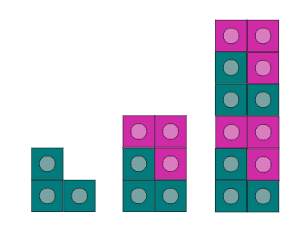
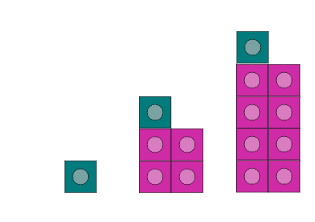
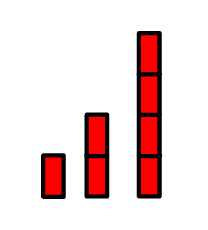
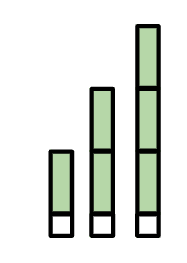
Q3.Which representation is the same sequence as this?
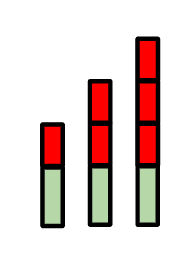
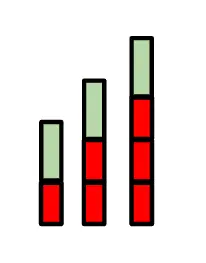
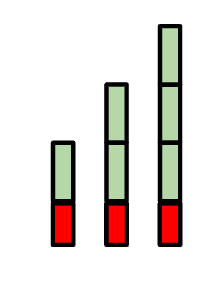
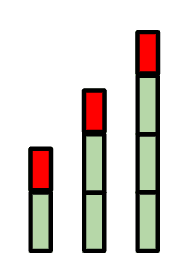
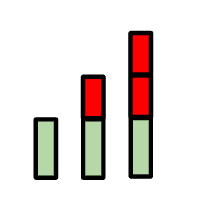
Q4.What would the next number in this sequence be if it had a constant additive rule? 2, -4, ,...
Q5.What would the next number in the sequence be if it had a constant multiplicative rule? 2, -4, , ...
Q6.Match the next 2 numbers in the sequence which starts 5, 15, ... with the rule the sequence is following.
..., 25, 35, ... - add 10
..., 45, 135, ... - multiply by 3
..., 45, 95, ... - add 10, add 30, add 50, add 70....
..., 35, 75, ... - double the previous value then add 5
..., 35, 65, ... - add 10, add 20, add 30, add 40 ...
..., 55, 215, ... - multiply by 4 then subtract 5
