Separating an insoluble solid from a liquid
I can use my understanding of the properties of solids and liquids to work out how to separate some mixtures.


- Year 7
Separating an insoluble solid from a liquid
I can use my understanding of the properties of solids and liquids to work out how to separate some mixtures.
Lesson details
Key learning points
- Magnets attract iron and steel
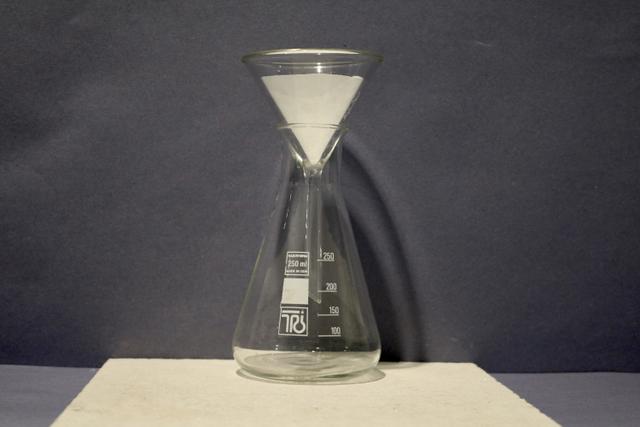
- Insoluble solids can be separated from a liquid using a filter by a process known as filtration.
- Filter paper is folded to make a pocket that fits in a filter funnel for filtering fine particles
- A drop of water on a filter funnel helps keep the filter paper cone open for easy filtering
Keywords
Filtration - The process of separating an insoluble substance from a liquid using a filter.
Filter paper - Paper with tiny holes, placed inside the filter funnel to separate an insoluble solid from a liquid.
Filter funnel - A cone-shaped tool with a tube, placed in the top of a conical flask during filtration.
Residue - The insoluble solid that remains in the filter paper.
Filtrate - The liquid that passes through the filter paper, separating from the insoluble solid.
Common misconception
A funnel is the same as a filter. Dissolved substances will be collected in the filter paper.
A filter separates materials. Dissolved substances are smaller than the pores in the filter paper and so will pass through with the liquid.


Equipment
See additional materials.

Content guidance
- Risk assessment required - equipment

Supervision
Adult supervision required

Licence
Lesson video
Loading...
Prior knowledge starter quiz
6 Questions
Q1.Which substances are insoluble (do not dissolve) in water?
Q2.A is a material that contains two or more different substances, which can be physically separated.
Q3.What mixture is formed when a substance dissolves in a liquid?
Q4.Match the following words to their meaning.

Q5.Iron is a material as it is attracted to magnets.
Q6.Which of the following are mixtures?
Assessment exit quiz
6 Questions
Q1.Some insoluble solids are more than a liquid and this property causes them to sink.
Q2.What is the name of the two separation techniques that involve mixtures being poured?
Q3.Match the words with their definitions.
Q4.Order the followings steps to show how to set up the equipment to perform the filtration of an insoluble solid in a liquid.
Q5.Filtration is used when making a cup of tea from a teabag. Match up the scientific word to the part involved in making the cup of tea.
Q6.Look at the image of filtering equipment. Choose the problems that could occur when filtering.