Set notation
I can use formal language for set notation and see how it relates to various representations.


- Year 11
Set notation
I can use formal language for set notation and see how it relates to various representations.
Lesson details
Key learning points
- Set notation is a shorter way of writing probability statements
- The notation relates to certain aspects of a probability tree
- The notation relates to certain aspects of a two-way table
- The notation relates to certain aspects of a Venn diagram
- The notation relates to certain aspects of a frequency tree
Keywords
Probability - The probability that an event will occur is the proportion of times the event is expected to happen in a suitably large experiment.
Venn diagram - Venn diagrams are a representation used to model statistical/probability questions. Commonly circles are used to represent events.
Tree diagram - Tree diagrams are a representation used to model statistical/probability questions. Branches represent different possible events or outcomes.
Common misconception
Pupils may think that A ∪ B means 'to be either from A or B (but not both)'.
A ∪ B represents all members that satisfy at least one of the events A or B. So it could be from A, from B or from both A and B.


Licence
Lesson video
Loading...
Prior knowledge starter quiz
6 Questions
Q1.In which of these situations is it not possible to work out a theoretical probability?

Q2.Izzy rolls a die 4 times. The dice lands on a '6' three times. Which of these statements are correct?
Q3.A spinner contains three letters: A, B and C. The tables show results from four experiments with the spinner. Which experiment will produce the most reliable set of experimental probabilities?

Q4.The table shows the theoretical probabilities of taking a counter of a specific colour out of a bag of counters. In 1000 trials, the number of times you should expect to draw a green counter is .

Q5.A box contains 100 counters. A counter is drawn, its colour noted and replaced. The results are in the table. Estimate how many green counters are in the box.

Q6.A class investigates whether a 6-sided die is biased. The table shows the results. Estimate the probability of the die landing on a factor of 6. P(factor of 6) = (as an unrounded decimal).

Assessment exit quiz
6 Questions
Q1.Which symbol is used to represent the universal set?
Q2.What does this symbol represent: ∩ ?
Q3.What region is shown shaded in this Venn diagram?

Q4.ξ = {1, 2, 3, 4, 5, 6, 7, 8, 9, 10, 11, 12}, A = {multiples of 4}, B = {factors of 12}. Find P(A' ∩ B).
Q5.Which combination of events is highlighted in the tree diagram?

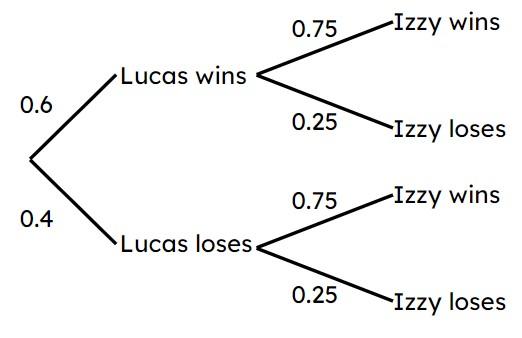
Q6.Lucas and Izzy each play one game of chess that they can either win or lose. P(Lucas wins ∪ Izzy wins) = (give your answer as a decimal).