Choose exam board for KS4 Computer Science (GCSE)
Choose exam board for KS4 English
Choose exam board for KS4 French
Choose exam board for KS4 Geography
Choose exam board for KS4 German
Choose exam board for KS4 History
Choose tier for KS4 Maths
Choose exam board for KS4 Music
Choose exam board for KS4 Physical education (GCSE)
Choose exam board for KS4 Religious education (GCSE)
Choose exam board for KS4 Spanish
      New
      New

      Strongest magnet (non-statutory)

      I can explore the strength of different magnets and find fair ways to compare them.

      Lesson 8 of 12
      New
      New
      • Year 3

      Strongest magnet (non-statutory)

      I can explore the strength of different magnets and find fair ways to compare them.

      Lesson details

      Key learning points

      1. Magnets vary in strength, with strong magnets creating larger magnetic forces
      2. Magnetic forces can act at a distance, so magnets do not need to be touching to exert a force
      3. Scientists ask questions and then plan how to carry out the right type of investigation to find answers
      4. The results of a scientific investigation can be compared to other investigations that have been carried out

      Keywords

      • Strength - The strength of something is shown by how well it can withstand a force or pressure.

      • Magnetic force - Magnetic force is the force caused by a magnet.

      • Material - The material is the thing that objects are made from such as wood, metal or plastic.

      • Distance - The distance between two points is the length of space between them.

      • Compare - We compare things by looking at what is the same and what is different.

      Common misconception

      Larger magnets are always stronger than smaller magnets.

      Explicit teaching as well as opportunities for children to explore different size magnets and their strengths.

      In the second and third learning cycles, make sure children are aware of the ways in which they are working like a scientist. Remind them that results may not always show what they expect but that does not mean the investigation went “wrong”.
      Teacher tip

      Equipment

      Magnets, rulers and magnetic materials. See additional materials for more guidance.

      Content guidance

      • Risk assessment required - equipment
      • Exploration of objects

      Supervision

      Adult supervision required

      Licence

      This content is © Oak National Academy Limited (2026), licensed on Open Government Licence version 3.0 except where otherwise stated. See Oak's terms & conditions (Collection 2).

      Lesson video

      Loading...

      Prior knowledge starter quiz

      6 Questions

      Q1.
      Which material are all magnets made of?

      Correct answer: metal
      wood
      plastic

      Q2.
      A magnet is a metal which attracts...

      some plastics
      all metals
      Correct answer: some metals
      all plastics

      Q3.
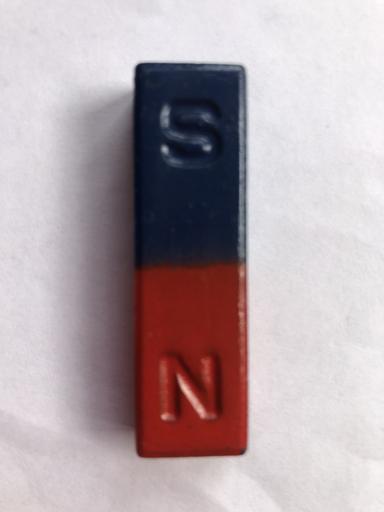
      What does the S on the end of a bar magnet stand for?
      An image in a quiz
      Correct answer: south-seeking
      south-avoiding
      south-facing

      Q4.
      If a force acts without objects touching each other, it is called a ...

      contact force
      Correct answer: non-contact force
      touching force
      contact free force

      Q5.
      Match the force to its type.

      Correct Answer:magnetic force,non-contact force
      Correct Answer:friction force,contact force

      Q6.
      William Gilbert discovered that the Earth was like a giant...

      Correct Answer: magnet, bar magnet

      Assessment exit quiz

      6 Questions

      Q1.
      Stronger magnets create magnetic forces.

      Correct Answer: stronger, larger, bigger, greater

      Q2.
      Magnets do not need to be __________ an object to cause a force.

      near
      close to
      Correct answer: touching

      Q3.
      Starting with 'ask a question', sort these activities into the order that a scientist would usually do them.

      1 - ask a question
      2 - plan an investigation
      3 - do an investigation
      4 - record the results
      5 - compare results

      Q4.
      Which of these are reasons why scientists compare their results?

      Correct answer: to look for patterns
      to meet other scientists
      Correct answer: to check whether results are reliable

      Q5.
      Match the measurement the scientist wants to make, with the investigation they should try.

      Correct Answer:Magnetic strength by distance,Measure how far away a magnet could attract an iron nail.
      Correct Answer:Magnetic strength by mass,Measure how many iron nails a magnet could hold.

      Q6.
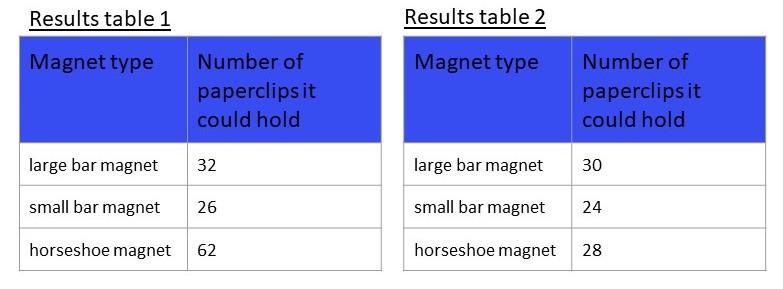
      Yes or no - Do these results suggest that the same magnet is the strongest?
      An image in a quiz
      Correct Answer: No, no

      Lesson appears in

      UnitScience / Simple forces including magnets

      Science