- Year 8
Surface area of prisms
I can find the surface area of 3D shapes in an efficient way.
Lesson details
Key learning points
- The surface area of a 3D shape is the sum of the area of all the faces.
- The net of a prism can help find the surface area of a prism but can be time consuming.
- By using known area facts, the area of all the faces can be found and summed.
- It is important to find the surface area systematically and efficiently.
Keywords
Prism - polyhedron with base and identical parallel opposite side with corresponding edges joined by parallelograms.
Faces - Faces are the flat 2D surfaces of a 3D shape.
Nets - The net of a 3D object is a 2D representation of its faces that can be folded up into the 3D object.
Surface area - The surface area is the total area of all the surfaces of a closed 3D shape. The surfaces include all faces and any curved surfaces.
Common misconception
Pupils may try to avoid sketching of nets or faces and in turn miss information.
Reassure pupils that a sketch does not need to be perfect and just needs to convey the key information.


Licence
Lesson video
Loading...
Prior knowledge starter quiz
6 Questions
Q1.The area of a rectangle with a width of 7 cm and a length of 12 m is m².

Q2.The area of a triangle with a base length of 14 cm and a perpendicular height of 8 cm is cm².
Q3.The area of a trapezium is being calculated $${\text {Area}}={{1}\over{2}} \times {(6+16)} \times {12} = 132 \text{ cm}^2$$. What is the perpendicular height of this trapezium?
Q4.A prism is a polyhedron with a base that is a and a parallel opposite face that is identical. The corresponding edges of the two polygons are joined by parallelograms.
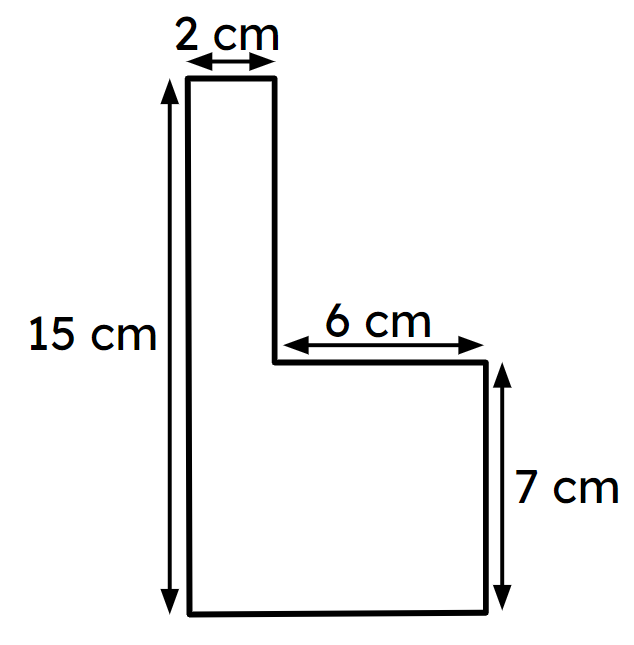
Q5.The perimeter of this shape is cm.
Q6.Match the shape of the base with the name of the prism.
rectangular base - cuboid
square base - cube
pentagonal base - pentagonal prism
triangular base - triangular prism
Assessment exit quiz
6 Questions
Q1.The surface area is the area of all the surfaces of a closed 3D shape. The surfaces include all faces and any curved surfaces.
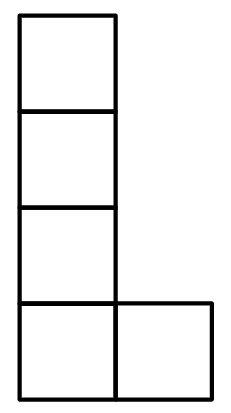
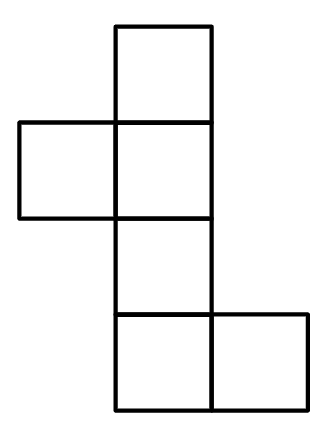
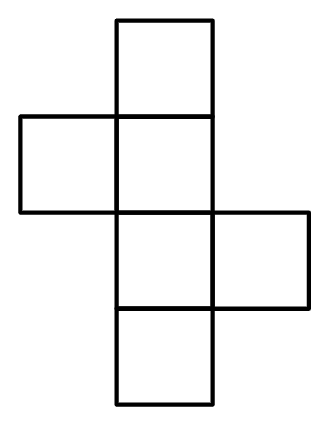
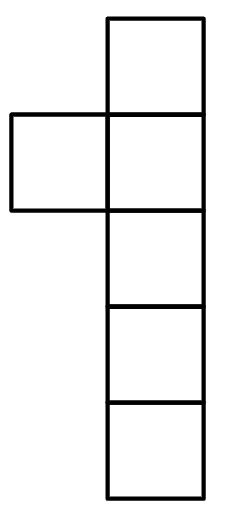
Q2.Which of these are nets for a cube?
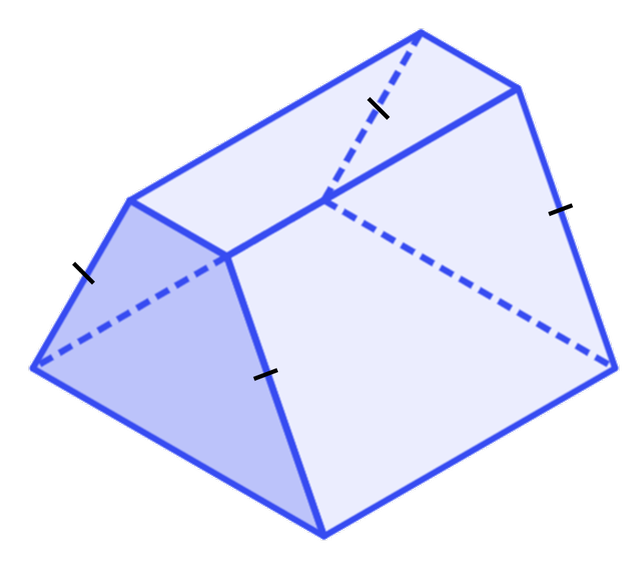
Q3.Here is a right prism. Which of these descriptions is correct?
Q4.The areas of the faces of a triangular prism are $$24\text{ cm}^2,24\text{ cm}^2,50\text{ cm}^2, 40\text{ cm}^2\text{ and }30\text{ cm}^2$$ respectively. The surface area is $$\text{ cm}^2$$.
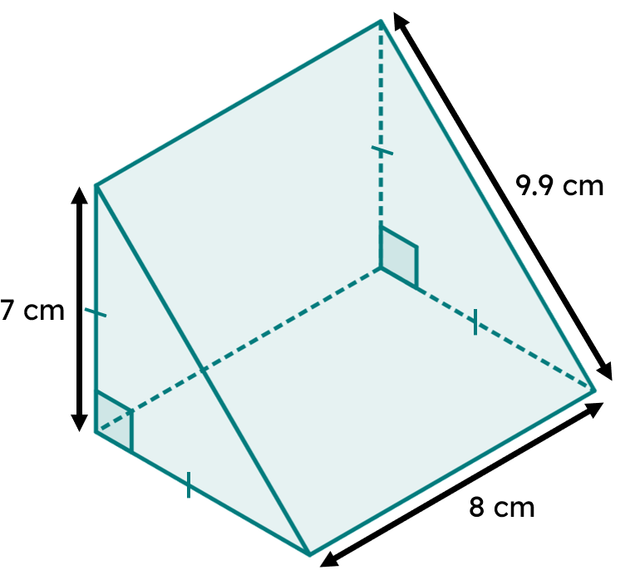
Q5.The surface area of this right-angled isosceles triangular prism is $$\text{ cm}^2$$.
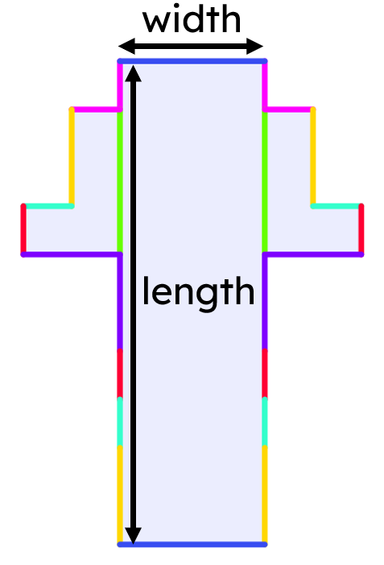
Q6.In a right prism, the rectangular faces can be seen as one large rectangle. The dimensions of the large rectangle are the of the base by the length of the prism.