Choose exam board for KS4 Computer Science (GCSE)
Choose exam board for KS4 English
Choose exam board for KS4 French
Choose exam board for KS4 Geography
Choose exam board for KS4 German
Choose exam board for KS4 History
Choose tier for KS4 Maths
Choose exam board for KS4 Music
Choose exam board for KS4 Physical education (GCSE)
Choose exam board for KS4 Religious education (GCSE)
Choose exam board for KS4 Spanish
      New
      New

      Use knowledge of the distributive law to solve further two-part problems

      I can use knowledge of the distributive law to solve two part subtraction problems efficiently.

      Lesson 2 of 5
      New
      New
      • Year 4

      Use knowledge of the distributive law to solve further two-part problems

      I can use knowledge of the distributive law to solve two part subtraction problems efficiently.

      Lesson details

      Key learning points

      1. Partitioning a factor is called distribution or using the distributive law.
      2. Partitioned factors can be subtracted to simplify two-part subtraction problems.
      3. Eight 9s subtract three 9s is equal to five 9s.

      Keywords

      • Common factor - When we compare lists of factors of two or more numbers, any factors that are the same are the common factors.

      • Distributive law - The distributive law says that multiplying a number by a group of numbers added together is the same as doing each multiplication separately.

      Common misconception

      When looking at an expression such as 5 × 6 − 5 × 3 children might be tempted to subtract first leading to an expression like this: 5 × 1 × 3

      Ensure that you support the equation with the arrays so that pupils understand where the multiplication expressions come from and they can match the partial products to the arrays.

      Consider the contexts used within this lesson and adapt if needed to suit the needs of your class.
      Teacher tip

      Licence

      This content is © Oak National Academy Limited (2025), licensed on Open Government Licence version 3.0 except where otherwise stated. See Oak's terms & conditions (Collection 2).

      Lesson video

      Loading...

      Prior knowledge starter quiz

      6 Questions

      Q1.
      Which of the numbers in the following equation is the product? 18 = 6 × 3

      Correct answer: 18
      6
      3

      Q2.
      44 + 13 =

      Correct Answer: 57

      Q3.
      54 + 35 =

      Correct Answer: 89

      Q4.
      Which of the following expressions represents the total number of apples if I have 3 bags of 7 apples and 3 bags of 5 apples.

      3 × 3 + 5 × 7
      Correct answer: 3 × 7 + 3 × 5
      3 × 3 + 7 × 5
      3 + 7 + 3 + 5

      Q5.
      Which of the following expressions is the array representing?
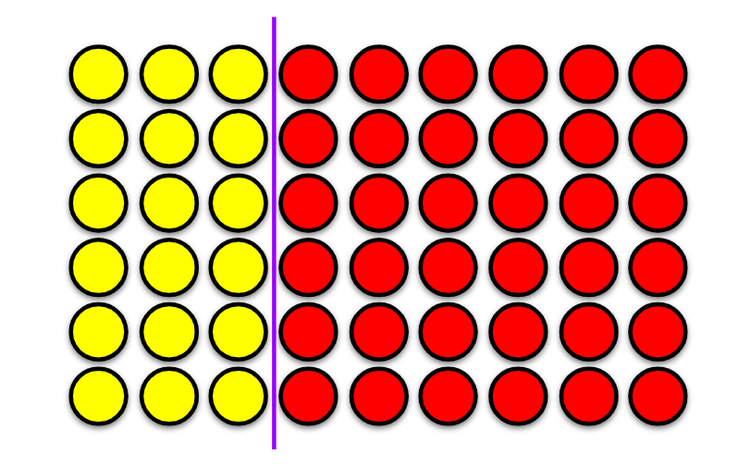
      An image in a quiz
      Correct answer: 6 × 3 + 6 × 6
      3 × 8 + 6 × 6
      6 × 6 + 6 × 9
      8 × 6 + 6 × 6

      Q6.
      Double 72 is ___

      138
      140
      142
      Correct answer: 144

      Assessment exit quiz

      6 Questions

      Q1.
      What is the common factor of the two multiplication expressions being added together in this equation? 6 × 5 − 4 × 5

      Correct Answer: 5, five

      Q2.
      Match the expressions that have equal value.

      Correct Answer:6 × 5 − 2 × 5,4 × 5
      Correct Answer:6 × 5 − 3 × 5,3 × 5
      Correct Answer:6 × 7 − 6 × 3,6 × 4

      Q3.
      Solve this equation using the distributive law. 8 × 4 − 3 × 4 =

      Correct Answer: 20

      Q4.
      Solve this equation using the distributive law. 7 × 5 − 2 × 5 = {{ }

      Correct Answer: 25

      Q5.
      There are 10 boxes of 6 eggs on the shelf. 4 boxes fall off and the eggs inside all break. How many eggs are left on the shelf? eggs

      Correct Answer: 36

      Q6.
      Aisha gets £8 pocket money each week but chooses to spend only £3 of it and save the rest. How much will she save after 8 weeks? £

      Correct Answer: 40, 40.00, £40

      Lesson appears in

      UnitMaths / Apply the distributive law to multiplication