


New
New
Use known facts and mental strategies to calculate with decimal numbers within and across a whole
I can use known facts and mental strategies to calculate with decimal numbers within and across a whole.


Lesson 3 of 5
New
New
- Year 5
Use known facts and mental strategies to calculate with decimal numbers within and across a whole
I can use known facts and mental strategies to calculate with decimal numbers within and across a whole.
Lesson details
Key learning points
- If you know that 5 + 2 is equal to 7 then 5 tenths + 2 tenths is equal to 7 tenths so 0.5 + 0.2 = 0.7
- Use known facts and unitising to add tenths.
- Bridging 10 strategies with whole numbers can be applied when the tenths bridge one whole.
Keywords
Number facts - Simple calculations using two numbers are known as number facts. For example 2 + 4 = 6
Bridging - Bridging is a mental strategy which uses addition or subtraction to cross a number boundary.
Common misconception
Pupils record missing part equations incorrectly.
Encourage children to match the equation to a representation identifying which number represents the wholes and which represent parts.
Use the language of unitising to support pupils each time. For example: I know 10 ones minus 3 ones is equal to 7 ones so 10 tenths minus 3 tenths is equal to 7 tenths.

Teacher tip

Licence
This content is © Oak National Academy Limited (2025), licensed on Open Government Licence version 3.0 except where otherwise stated. See Oak's terms & conditions (Collection 2).
Lesson video
Loading...
Prior knowledge starter quiz
6 Questions
Q1.Tick the number facts that make 10.
Tick the number facts that make 10.
4 + 7

Q2.Ten tenths are equal to
Ten tenths are equal to
Q3.I know 7 − 5 = 2 so 700 − 500 =
I know 7 − 5 = 2 so 700 − 500 =
Q4.Tick all of the equations that can represent this part-part-whole model.
Tick all of the equations that can represent this part-part-whole model.
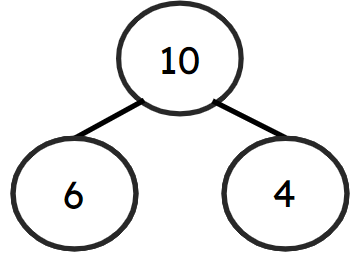
10 = 6 − 4
6 = 10 + 4
Q5.I know 12 − 5 = 7 so 120 − 50 =
I know 12 − 5 = 7 so 120 − 50 =
7
17
170
Q6.What are the missing numbers that the nine would need to be partitioned into to bridge 10 for this example.
What are the missing numbers that the nine would need to be partitioned into to bridge 10 for this example.
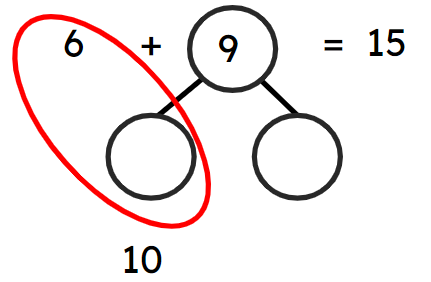
3 and 6
2 and 7
1 and 8
Assessment exit quiz
6 Questions
Q1.I know 3 + 6 = 9 so 0.3 + 0.6 =
I know 3 + 6 = 9 so 0.3 + 0.6 =
Q2.I know 8 − 5 = 3 so 0.8 − 0.5 =
I know 8 − 5 = 3 so 0.8 − 0.5 =
Q3.Which of these pairs of numbers sum to make 1?
Which of these pairs of numbers sum to make 1?
0.2 and 0.7
0.9 and 0.2
Q4.Use a known number fact to help you solve: 1 − 0.3 =
Use a known number fact to help you solve: 1 − 0.3 =
Q5.Fill in the missing number for the equation represented by the number line.
Fill in the missing number for the equation represented by the number line.
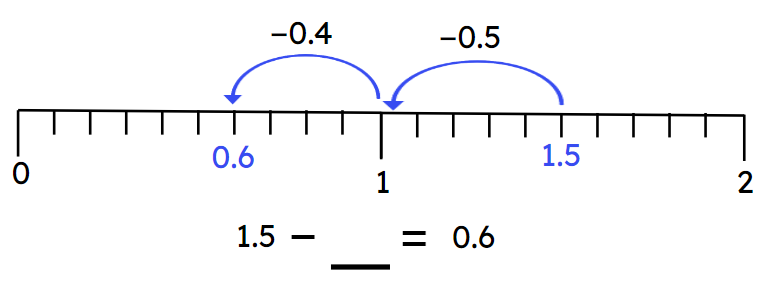
Q6.Fill in the missing number: ___ − 0.7 = 0.8
Fill in the missing number: ___ − 0.7 = 0.8
