Using the scale factor for enlarging a volume
I can calculate the scale factor used to enlarge a volume and use it to find missing lengths.


- Year 10
Using the scale factor for enlarging a volume
I can calculate the scale factor used to enlarge a volume and use it to find missing lengths.
Lesson details
Key learning points
- You can calculate the scale factor from the two volumes.
- Having calculated the scale factor, you can find missing lengths.
Keywords
Similar - Two shapes are similar if the only difference between them is their size. Their side lengths are in the same proportions.
Invariant - A property of a shape is invariant if that property has not changed after the shape is transformed.
Enlargement - Enlargement is a transformation that causes a change of size.
Scale factor - A scale factor is the multiplier between similar shapes that describes how large one shape is compared to the other.
Volume - Volume is the amount of space occupied by a closed 3D shape.
Common misconception
A linear scale factor can only be found by finding the multiplicative relationship between two corresponding lengths.
A linear scale factor can also be found by cube rooting a volume scale factor, where the volume scale factor is found from the multiplicative relationship between the volumes of two similar 3D shapes.


Licence
Lesson video
Loading...
Prior knowledge starter quiz
6 Questions
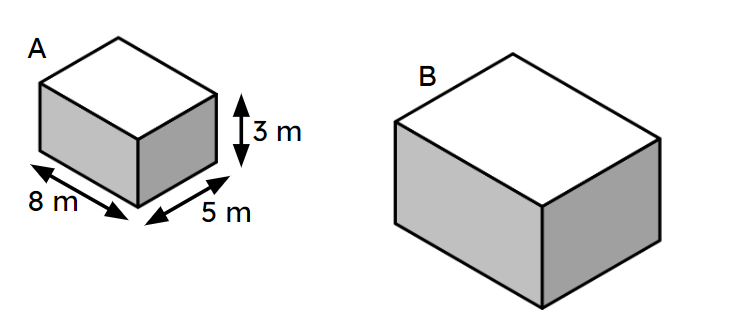
Q1.Volume is the amount of occupied by a closed 3D shape.

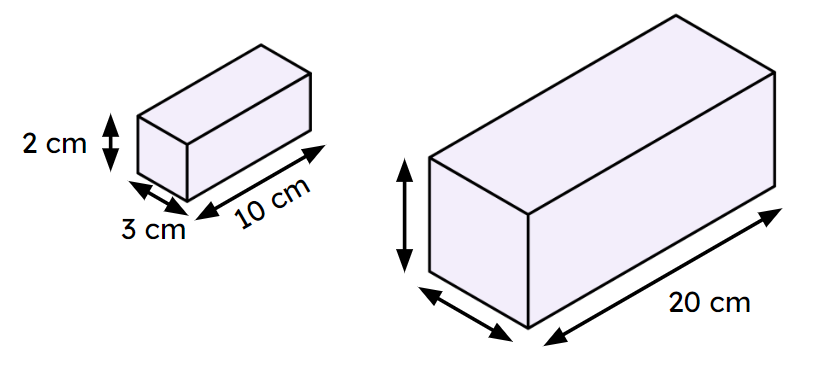
Q2.A cuboid of dimensions 2 cm by 3 cm by 10 cm is enlarged by a scale factor of 2. Work out the volume of the enlarged cuboid.
Q3.Shape A is a 3D shape. Shape A is enlarged by scale factor 5 to give shape B. What is the volume scale factor from A to B?
Q4.Match each linear scale factor to correct the volume scale factor.
Linear scale factor: $$3$$ - Volume scale factor: $$27$$
Linear scale factor: $$10$$ - Volume scale factor: $$1000$$
Linear scale factor: $$2$$ - Volume scale factor: $$8$$
Linear scale factor: $$6$$ - Volume scale factor: $$216$$
Linear scale factor: $$9$$ - Volume scale factor: $$729$$
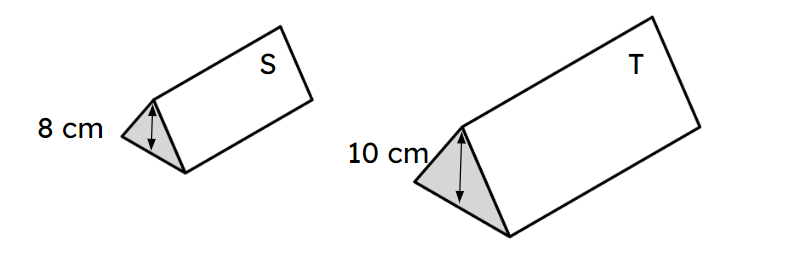
Q5.Prism S and prism T are similar. What is the scale factor of enlargement from prism S to prism T?
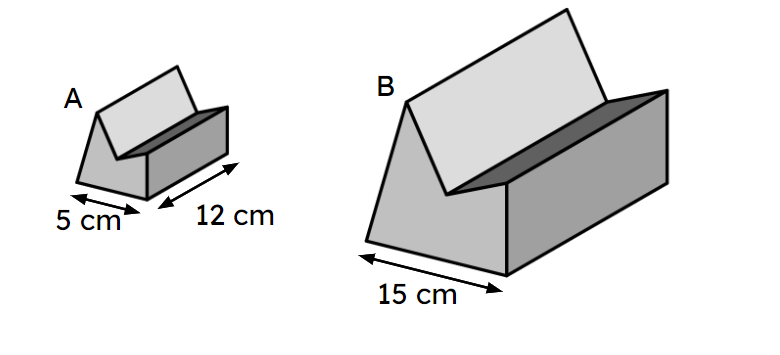
Q6.Prism A and prism B are similar. The end face of prism A has an area of 20 cm². The volume of prism B is cm³.
Assessment exit quiz
6 Questions
Q1.A scale factor is the multiplier between shapes that describes how large one shape is compared to the other.
Q2.The multiplier between corresponding edge lengths on a pair of similar objects is $$k$$. Select the correct statements.
Q3.Shapes X and Y are similar to each other. The volume of shape Y is 729 times larger than the volume of shape X. The linear scale factor from X to Y is .
Q4.Shapes X and Y are similar. The volume of shape Y is 729 times larger than the volume of shape X. The area scale factor from X to Y is .
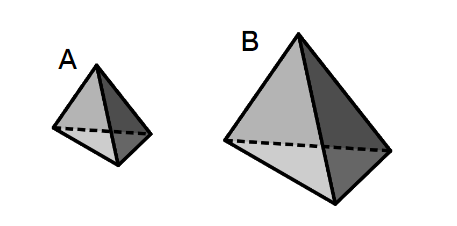
Q5.Pyramid A and pyramid B are similar. The surface area of pyramid A is 50 cm² and its volume is 120 cm³. The surface area of pyramid B is 200 cm². Calculate the volume of pyramid B.
Q6.Cuboid A and cuboid B are similar. The volume of cuboid B is 405 cm³. The surface area of B is cm².