Choose exam board for KS4 Computer Science (GCSE)
Choose exam board for KS4 English
Choose exam board for KS4 French
Choose exam board for KS4 Geography
Choose exam board for KS4 German
Choose exam board for KS4 History
Choose tier for KS4 Maths
Choose exam board for KS4 Music
Choose exam board for KS4 Physical education (GCSE)
Choose exam board for KS4 Religious education (GCSE)
Choose exam board for KS4 Spanish

      Lesson details

      Learning outcome

      I can describe how the structures of blood and blood vessels are adapted to their functions.

      Key learning points

      1. Blood contains blood cells suspended in a fluid called plasma.
      2. Red blood cells transport oxygen, and have a structure adapted to carry as much oxygen as possible.
      3. Plasma transports water, glucose and other nutrients, and waste products including carbon dioxide and urea.
      4. Arteries carry blood away from the heart; capillaries carry blood to/from cells; veins carry blood back to the heart.
      5. Arteries, capillaries and veins have structures adapted to their functions, including different vessel walls and valves.

      Keywords

      • Red blood cell - A blood cell that uses haemoglobin to bind and transport oxygen.

      • Plasma - The fluid of the blood which carries blood cells and other substances.

      • Artery - Large blood vessels with thicker walls which transport blood away from the heart.

      • Vein - Large blood vessel which transports blood towards the heart.

      • Capillary - Narrow blood vessel which allows exchange of substances between tissue and blood.

      Common misconception

      The names of the blood vessels and their functions and adaptations are often confused. Students often forget or misunderstand red blood cell adaptations too.

      Both these areas are covered in detail, with clear step-by-step information given and tasks to check learning and reinforce understanding.

      Teacher tip

      Use donuts or playdoh to show the 3D shape of red blood cells, students could even have a go at modelling it. Arteries, veins and capillaries could be compared to road systems (motorways, A and B roads, and tracks) or water pipes from a house to a large sewer to provide a familiar link.

      Equipment

      None

      Licence

      This content is © Oak National Academy Limited (2026), licensed on Open Government Licence version 3.0
      except where otherwise stated. See Oak's terms & conditions
      (Collection 2).

      Lesson video

      Loading...

      Prior knowledge starter quiz

      6 Questions

      Q1.
      Which of these is a waste product in humans?

      Amino acids
      Carbohydrates
      Correct answer: Carbon dioxide
      Mineral ions
      Oxygen

      Q2.
      Why is the heart described as an organ?

      It is made from cardiac muscle cells.
      It is part of an organ system.
      It acts as a pump pushing blood round the body.
      Correct answer: It is made from several different tissues.

      Q3.
      Nitrogenous waste produced by cells is transported by the blood to which organ?

      Correct Answer: Kidney, kidney, kidneys, Kidneys

      Q4.
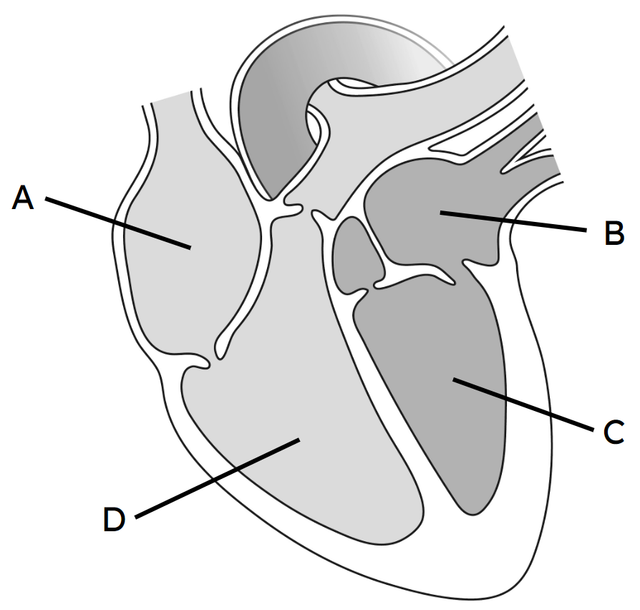
      In the diagram of the human heart, which letter (A, B, C or D) is the left ventricle?

      An image in a quiz
      Correct Answer: C, c

      Q5.
      Starting with the lungs, put these structures in the correct order to describe blood flow through the left side of the heart.

      1 - Lungs
      2 - Pulmonary vein
      3 - Left atrium
      4 - Atrio-ventricular valve
      5 - Left ventricle
      6 - Aorta

      Q6.
      True or false? The pulmonary artery carries oxygenated blood.

      Correct Answer: False, false

      6 Questions

      Q1.
      Match each word to its correct description.

      Correct Answer:Artery,blood vessel that carries blood away from the heart

      blood vessel that carries blood away from the heart

      Correct Answer:Capillary,where exchange of substances between blood and body cells takes place

      where exchange of substances between blood and body cells takes place

      Correct Answer:Vein,blood vessel that carries blood towards the heart

      blood vessel that carries blood towards the heart

      Q2.
      Which substance in the list is not mainly transported in the blood plasma?

      Amino acids
      Carbon dioxide
      Glucose
      Correct answer: Oxygen
      Urea

      Q3.
      Which of the adaptations of a red blood cell increases the rate of diffusion of oxygen?

      Absence of a nucleus
      Correct answer: Biconcave shape
      Presence of protein haemoglobin
      Presence of Fe$$^2+$$ ions

      Q4.
      Blood vessels are adapted to their function. Which blood vessels are adapted by having thick elastic and muscular walls and narrow lumens?

      Correct Answer: Arteries, Artery, arteries, artery

      Q5.
      True or false? The exchange of substances between the blood and body cells only takes place from capillaries.

      Correct answer: True
      False

      Q6.
      Some blood vessels contain valves. What is the function of these valves?

      To speed up blood flow.
      To slow blood flow.
      To push blood forward.
      Correct answer: To prevent back flow of blood.

      To help you plan your 10 combined science lesson on: Human blood cells and blood vessels, download all teaching resources for free and adapt to suit your pupils' needs...