


Jobs: singular 'avoir' or 'être', questions with 'est-ce que'
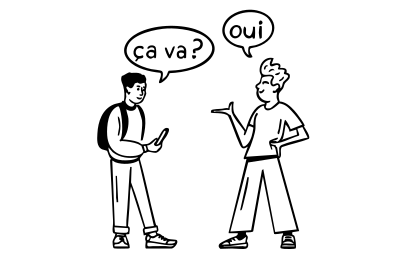




Lesson details
Learning outcome
I can ask 'est-ce que' questions about people using the verbs 'avoir' and 'être'.
Vocabulary and transcripts for this lessons
Key learning points
- French is not a stress-timed language. Sound all vowels. Say syllables equally with a slight emphasis on the last one.
- 'Avoir' means 'to have, having', 'j'ai' means 'I have', 'tu as' means 'you have'.
- 'Être' means 'to be, being', 'je suis' means 'I am', 'il est' means 'he is' and 'elle est' means 'she is'.
- When using 'être' to describe professions, no article (un/une) is needed before the job noun in French.
- Ask questions in French with intonation, inversion and 'est-ce que'. Inversion is more formal than 'est-ce que'.
Keywords
Stress - pronouncing one syllable more heavily than other syllables in a word
Intonation - rise and fall of the voice in speaking
Inversion - when the subject pronoun and the verb switch place to form a question
Common misconception
There is no need to use intonation when using inversion and 'est-ce que'.
Even when we form questions with inversion or 'est-ce que', it is still important to use intonation to signal that it is a question.
Teacher tip
Teachers may find it helpful to support their teaching of intonation questions by using hand gestures to model rising intonation. Some pupils may find it helpful to use the same gestures themselves initially, as they practise.

Licence

Lesson video
Loading...
Some of our videos, including non-English language videos, do not have captions.
Prior knowledge starter quiz
6 Questions
Q1.Tick the correct definition of 'intonation'.
Q2.Match the modal verbs in French and English.

Q3.Put the numbers in numerical order starting from smallest to biggest.
Q4.Fill in the missing possessive adjective in the sentence 'Are you doing your homework?' 'Tu fais devoirs ?'
Q5.What is the verb 'to work' in French?
Q6.Order the French sentence 'Here is my TV and my computer in my bedroom'.
Assessment exit quiz
6 Questions
Q1.When would you be more likely to use an 'est-ce que' question?
Q2.Match up the parts of 'avoir' and 'être' in French and English.
Q3.In French, sound all syllables equally with a slight emphasis on the syllable.
Q4.Order the sentence 'he is a secretary and she is a lawyer' in French.
Q5.Add the missing word to the sentence 'Does she want to be a headteacher?' 'Veut- être directrice ?'
Q6.Order the French sentence 'Is he an intelligent man?'
To help you plan your 8 French lesson on: Jobs: singular 'avoir' or 'être', questions with 'est-ce que', download all teaching resources for free and adapt to suit your pupils' needs...
To help you plan your 8 French lesson on: Jobs: singular 'avoir' or 'être', questions with 'est-ce que', download all teaching resources for free and adapt to suit your pupils' needs.
The starter quiz will activate and check your pupils' prior knowledge, with versions available both with and without answers in PDF format.
We use learning cycles to break down learning into key concepts or ideas linked to the learning outcome. Each learning cycle features explanations with checks for understanding and practice tasks with feedback. All of this is found in our slide decks, ready for you to download and edit. The practice tasks are also available as printable worksheets and some lessons have additional materials with extra material you might need for teaching the lesson.
The assessment exit quiz will test your pupils' understanding of the key learning points.
Our video is a tool for planning, showing how other teachers might teach the lesson, offering helpful tips, modelled explanations and inspiration for your own delivery in the classroom. Plus, you can set it as homework or revision for pupils and keep their learning on track by sharing an online pupil version of this lesson.
Explore more key stage 3 French lessons from the Jobs: 'avoir' and 'être', feminine nouns unit, dive into the full secondary French curriculum, or learn more about lesson planning.