


Weathering and mass movement at the coast



Lesson details
Learning outcome
I can explain how weathering and mass movement shape the coast.
Key learning points
- The coast is shaped by weathering processes (mechanical and chemical).
- The coast is shaped by processes of mass movement (sliding, slumping and rock falls).
Keywords
Weathering - the breakdown or disintegration of rocks at or close to the surface
Mechanical weathering - physical disintegration of rocks, for example through freeze-thaw
Chemical weathering - chemical breakdown of rocks usually involving slightly acidic rainwater
Mass movement - the downhill movement of material under the influence of gravity
Common misconception
Mass movement only refers to dramatic events like landslides and rockfalls.
Mass movement includes all downhill movements of soil, rock, or debris due to gravity. It's not just rapid events like landslides but also slower processes which occur gradually and can still significantly alter the landscape over time.
Teacher tip
GIS could be used in this lesson to explore the impact of landslides and identify areas most at risk. The National Trust has an ArcGIS resource on climate hazards which could be used for this called Slope Failure (Landslides) Current.

Licence

Lesson video
Loading...
Prior knowledge starter quiz
6 Questions
Q1.Which of the following characteristics best describes constructive waves?

Q2.What type of erosion involves rocks and pebbles colliding and breaking into smaller, rounder pieces?
Q3.Which type of erosion is defined as material being hurled against a cliff face, wearing it down?
Q4.What process is being described here "the uninterrupted distance over which the wind blows across the water"?
Q5.Reorder the steps in the process of longshore drift:
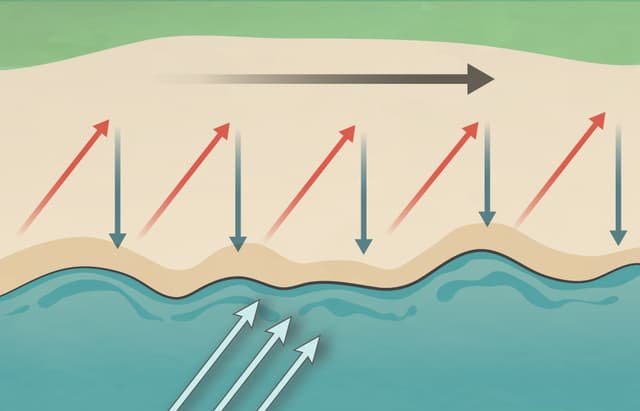
Q6.What coastal management structure is used to block longshore drift?
Assessment exit quiz
4 Questions
Q1.Which of the following is an example of chemical weathering?
Q2.What happens during freeze-thaw weathering?
Q3.Which type of mass movement involves rocks breaking away from a cliff and falling freely down to the bottom of the cliff?
Q4.What is a key characteristic of slumping as a type of mass movement?
To help you plan your 10 geography lesson on: Weathering and mass movement at the coast, download all teaching resources for free and adapt to suit your pupils' needs...
To help you plan your 10 geography lesson on: Weathering and mass movement at the coast, download all teaching resources for free and adapt to suit your pupils' needs.
The starter quiz will activate and check your pupils' prior knowledge, with versions available both with and without answers in PDF format.
We use learning cycles to break down learning into key concepts or ideas linked to the learning outcome. Each learning cycle features explanations with checks for understanding and practice tasks with feedback. All of this is found in our slide decks, ready for you to download and edit. The practice tasks are also available as printable worksheets and some lessons have additional materials with extra material you might need for teaching the lesson.
The assessment exit quiz will test your pupils' understanding of the key learning points.
Our video is a tool for planning, showing how other teachers might teach the lesson, offering helpful tips, modelled explanations and inspiration for your own delivery in the classroom. Plus, you can set it as homework or revision for pupils and keep their learning on track by sharing an online pupil version of this lesson.
Explore more key stage 4 geography lessons from the Coastal landscapes unit, dive into the full secondary geography curriculum, or learn more about lesson planning.