


Summer plans: present tense (future meaning) 1st person, 'nächst-'




Lesson details
Learning outcome
I can express my plans for the future by using time phrases with 'nächst-' and the present tense, in the 1st person singular and plural.
Vocabulary and transcripts for this lessons
Key learning points
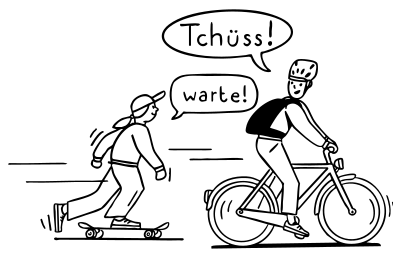
- [s] sounds like the English 'z' before a vowel. Elsewhere [s], 'ss' and [ß] sound like the English 's'.
- Write 'ss' after a short vowel but [ß] after a long vowel like 'Fuß' or after 2 vowels together like 'weiß'.
- 'Nächst-' means 'next' and takes the same ending as the definite article of the noun it precedes.
- Use a time adverbial with the present tense to express what you are doing in future, e.g., 'Nächste Woche tanze ich'.
- When translating future meaning from German into English, use the present continuous tense (i.e., 'I am going to').
Keywords
[s] - pronounced as in 'sollen'
[ß], [ss] - pronounced as in 'groß'
Time phrase - a multi-word phrase that describes when something happens, e.g., 'am Montag'
Nächst- - 'next'
Tense - form of a verb that expresses time (past, present, future)
Common misconception
The spellings 'ss' and 'ß' make different sounds.
The spellings 'ss' and 'ß' make the same sound, but write 'ss' after a short vowel, 'ß' after a long vowel.
Teacher tip
Task A2 could be completed as a mini-whiteboard task for increased pace and instant assessment for learning.

Licence

Lesson video
Loading...
Some of our videos, including non-English language videos, do not have captions.
Prior knowledge starter quiz
6 Questions
Q1.Put the following numbers in order, starting with the lowest.
Q2.Match up the German and English words.

Q3.Match each German word to its English meaning,
Q4.How do we pronounce the letter 'j' in German?
Q5.Complete the translation: 'mit deiner Mutter' - 'with __________ mother'.
Q6.Complete the translation: 'Der Film dauert zwei Stunden.' - 'The film two hours.'.
Assessment exit quiz
5 Questions
Q1.When does an [s] sound like a 'z' in German?
Q2.When is ‘ß’ written instead of ‘ss’?
Q3.What does the letter [ß] sound like?
Q4.Match each form of 'nächst-' with the correct word to make a future time phrase.
Q5.Which of these is the best translation of the following sentence? 'Nächstes Wochenende arbeite ich zu Hause.'
To help you plan your 7 German lesson on: Summer plans: present tense (future meaning) 1st person, 'nächst-', download all teaching resources for free and adapt to suit your pupils' needs...
To help you plan your 7 German lesson on: Summer plans: present tense (future meaning) 1st person, 'nächst-', download all teaching resources for free and adapt to suit your pupils' needs.
The starter quiz will activate and check your pupils' prior knowledge, with versions available both with and without answers in PDF format.
We use learning cycles to break down learning into key concepts or ideas linked to the learning outcome. Each learning cycle features explanations with checks for understanding and practice tasks with feedback. All of this is found in our slide decks, ready for you to download and edit. The practice tasks are also available as printable worksheets and some lessons have additional materials with extra material you might need for teaching the lesson.
The assessment exit quiz will test your pupils' understanding of the key learning points.
Our video is a tool for planning, showing how other teachers might teach the lesson, offering helpful tips, modelled explanations and inspiration for your own delivery in the classroom. Plus, you can set it as homework or revision for pupils and keep their learning on track by sharing an online pupil version of this lesson.
Explore more key stage 3 German lessons from the Plans and places: future vs present meaning for present tense unit, dive into the full secondary German curriculum, or learn more about lesson planning.