Choose exam board for KS4 Computer Science (GCSE)
Choose exam board for KS4 English
Choose exam board for KS4 French
Choose exam board for KS4 Geography
Choose exam board for KS4 German
Choose exam board for KS4 History
Choose tier for KS4 Maths
Choose exam board for KS4 Music
Choose exam board for KS4 Physical education (GCSE)
Choose exam board for KS4 Religious education (GCSE)
Choose exam board for KS4 Spanish

      Use known facts to derive common conversions over 1
      Lesson details

      Learning outcome

      I can use known facts to derive common conversions over 1

      Key learning points

      1. If 1 km is equal to one lot of 1,000 m, then 3 km is equal to three lots of 1,000 m, which is 3,000 m
      2. If 1 l = 1,000 ml, then 4 l = 4 x 1,000 ml = 4,000 ml

      Keywords

      • Equivalent - When two or more things have the same value.

      • Convert - Change a value or expression from one form to another.

      Common misconception

      Pupils may see, for example, 3.25 kg and convert it to 3 kg and 25 g rather than 3 kg and 250 g.

      The lesson presents fractions and decimals as parts of whole circles. As long as pupils know that 1 kg = 1,000 g, they should see from the representation that 0.25 kg = 250 g as 250 + 250 + 250 + 250 = 1,000

      Teacher tip

      Pupils will need to have a secure grasp of the content from the previous lesson where circles and parts of circles are used to represent fractions and decimals less than one. Scaffolds in the form of pre-labelled parts of circles can be provided initially to reduce load.

      Licence

      This content is © Oak National Academy Limited (2025), licensed on Open Government Licence version 3.0
      except where otherwise stated. See Oak's terms & conditions
      (Collection 2).

      Lesson video

      Loading...

      Prior knowledge starter quiz

      6 Questions

      Q1.
      Identify the unit fractions.

      Correct answer: $$ \frac{1}{5} $$
      Correct answer: $$ \frac{1}{7} $$
      Correct answer: $$ \frac{1}{2} $$
      $$ \frac{3}{5} $$
      $$ \frac{2}{4} $$

      Q2.
      Match the fraction notation with the decimal notation that is equivalent.

      Correct Answer:1 $$ \frac{1}{4} $$,1.25

      1.25

      Correct Answer:1 $$ \frac{3}{4} $$,1.75

      1.75

      Correct Answer:1 $$ \frac{7}{10} $$,1.7

      1.7

      Correct Answer:1 $$ \frac{1}{5} $$,1.2

      1.2

      Q3.
      $$ \frac{3}{4} $$ km = 0.75 km = m

      Correct Answer: 750, 750 m

      Q4.
      $$ \frac{4}{5} $$ m = 0.8 m = mm

      Correct Answer: 800, 800 mm

      Q5.
      $$ \frac{7}{10} $$ l = 0.7 l = ml

      Correct Answer: 700, 700ml

      Q6.
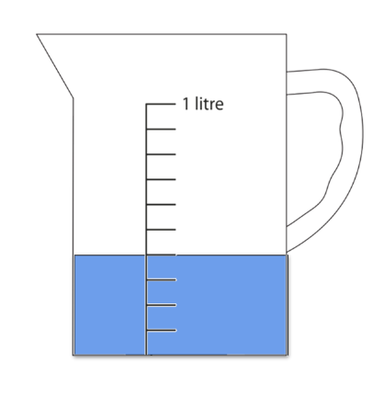
      How many ml of water is in this container? ml

      An image in a quiz
      Correct Answer: 400, 400ml

      6 Questions

      Q1.
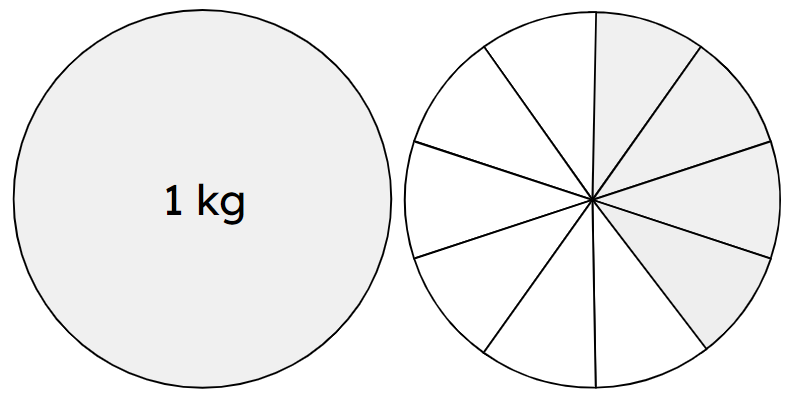
      Look at the image. What is this mass as a decimal?

      An image in a quiz
      0.4 kg
      Correct answer: 1.4 kg
      4.1 kg
      14 kg

      Q2.
      Look at the image. What is this mass as a mixed number?

      An image in a quiz
      1 $$ \frac{1}{4} $$ kg
      1 $$ \frac{4}{6} $$ kg
      Correct answer: 1 $$ \frac{4}{10} $$ kg

      Q3.
      Convert 5.6 kg into grams.

      Correct answer: 5,600 g
      560 g
      500 g
      5,000 g

      Q4.
      Convert 7.25 l into ml.

      7,000 ml
      725 ml
      Correct answer: 7,250 ml
      700 ml

      Q5.
      Convert 1.4 kg into grams. g

      An image in a quiz
      Correct Answer: 1,400, 1,400g, 1400

      Q6.
      Convert 8.75 km into m. m

      Correct Answer: 8,750 , 8,750 m, 8750

      To help you plan your 5 maths lesson on: Use known facts to derive common conversions over 1, download all teaching resources for free and adapt to suit your pupils' needs...