Choose exam board for KS4 Computer Science (GCSE)
Choose exam board for KS4 English
Choose exam board for KS4 French
Choose exam board for KS4 Geography
Choose exam board for KS4 German
Choose exam board for KS4 History
Choose tier for KS4 Maths
Choose exam board for KS4 Music
Choose exam board for KS4 Physical education (GCSE)
Choose exam board for KS4 Religious education (GCSE)
Choose exam board for KS4 Spanish

      Lesson details

      Learning outcome

      I can show that the probabilities of all possible unique outcomes for a trial, sum to one.

      Key learning points

      1. Summing the probabilities of all possible unique outcomes for a trial gives 1
      2. Summing the probabilities of non-unique events gives a value not equal to 1
      3. Knowing that the probabilities of all possible unique outcomes sum to 1 can be used to find unknown probabilities.
      4. Knowing that probabilities can sum to 1 can be used to find unknown probabilities (different denominators).

      Keywords

      • Mutually exclusive - Two events are mutually exclusive if they share no common outcome.

      Common misconception

      Pupils may over generalise and think that the sum of all possible events sum to 1. E.g. when rolling a standard six-sided dice, P(multiple of 6) + P(factor of 6) = 1.

      Emphasise that probabilities sum to 1 when the events are mutually exclusive and exhaustive. E.g. in the calculation P(multiple of 6) + P(factor of 6), the outcome '6' is counted twice.

      Teacher tip

      Question 1 in Task A could be extended by asking pupils to think of other sets of events that have probabilities which sum to 1 because they are both mutually exclusive and exhaustive.

      Licence

      This content is © Oak National Academy Limited (2026), licensed on Open Government Licence version 3.0
      except where otherwise stated. See Oak's terms & conditions
      (Collection 2).

      Lesson video

      Loading...

      Prior knowledge starter quiz

      6 Questions

      Q1.
      A __________ diagram is a representation used to model statistical/probability questions, where branches represent different possible events or outcomes.

      Correct Answer: tree, outcome tree

      Q2.
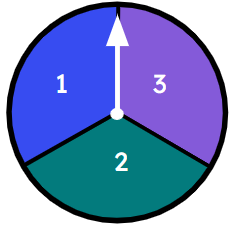
      What is the probability that the spinner lands on the number 2?

      An image in a quiz
      $${1}\over{2}$$
      Correct answer: $${1}\over{3}$$
      $${2}\over{3}$$
      $${2}\over{6}$$

      Q3.
      What is the probability that the spinner does not land on the number 2?

      An image in a quiz
      $${1}\over{2}$$
      $${1}\over{3}$$
      Correct answer: $${2}\over{3}$$
      $${2}\over{6}$$

      Q4.
      Which values represent the probability that this spinner lands on an integer?

      An image in a quiz
      $${1}\over{3}$$
      Correct answer: 1
      1%
      Correct answer: 100%
      Correct answer: $${3}\over{3}$$

      Q5.
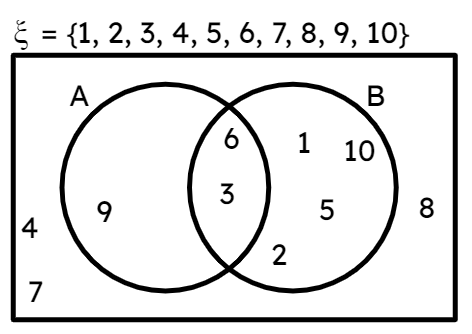
      Based on the Venn diagram, which numbers belong to both sets A and B?

      An image in a quiz
      1
      2
      Correct answer: 3
      Correct answer: 6
      9

      Q6.
      An integer between 1 and 10 is selected at random. Based on the Venn diagram, what is the probability that the outcome is from set A?

      An image in a quiz
      $${1}\over{7}$$
      $${3}\over{7}$$
      $${1}\over{10}$$
      Correct answer: $${3}\over{10}$$
      $${9}\over{10}$$

      6 Questions

      Q1.
      Two or more events are __________ if they share no common outcome.

      certain
      exhaustive
      impossible
      likely
      Correct answer: mutually exclusive

      Q2.
      A set of events are __________ if at least one of them has to occur whenever the experiment is carried out.

      certain
      Correct answer: exhaustive
      impossible
      likely
      mutually exclusive

      Q3.
      A standard six-sided dice is rolled. Which pairs of events are mutually exclusive?

      Correct answer: {odd, even}
      {prime, even}
      {factor of 6, multiple of 6}
      Correct answer: {6, lower than 6}
      Correct answer: {prime, square}

      Q4.
      A standard six-sided dice is rolled. Which pairs of events are exhaustive?

      Correct answer: {odd, even}
      {prime, even}
      Correct answer: {factor of 6, multiple of 6}
      Correct answer: {6, lower than 6}
      {prime, square}

      Q5.
      When a set of events are all mutually exclusive and exhaustive, their probabilities sum to .

      Correct Answer: 1, 100%, one, a whole, one whole

      Q6.
      The probability that a cone lands on its base is 0.1. What is the probability that the cone does not land on its base?

      Correct Answer: 0.9, 0.90, 90%

      To help you plan your 9 maths lesson on: Summing probabilities, download all teaching resources for free and adapt to suit your pupils' needs...