Choose exam board for KS4 Computer Science (GCSE)
Choose exam board for KS4 English
Choose exam board for KS4 French
Choose exam board for KS4 Geography
Choose exam board for KS4 German
Choose exam board for KS4 History
Choose tier for KS4 Maths
Choose exam board for KS4 Music
Choose exam board for KS4 Physical education (GCSE)
Choose exam board for KS4 Religious education (GCSE)
Choose exam board for KS4 Spanish

      Finding a percentage with a multiplier
      Lesson details

      Learning outcome

      I can find a percentage of a quantity using a multiplier.

      Key learning points

      1. A double number line can be used to find a percentage of a quantity.
      2. A ratio table can be used to find a percentage of an amount.
      3. A percentage can be written as a decimal called a multiplier.
      4. This multiplier can be used to find a percentage of an amount.

      Keywords

      • Associative law - The associative law states that a repeated application of the operation produces the same result regardless of how pairs of values are grouped. We can group using brackets.

      Common misconception

      A single digit percentage is incorrectly worked out by dividing by 10 and not 100 e.g 3% = 0.3

      Two responses can be used to remind students that to covert a percentage into a decimal; we divide by 100; using 3%, ask what 30% is as a decimal and 3% as a decimal. Pupils realise they cannot be the same. A place value chart also helps.

      Teacher tip

      Using a multiplier is a more effective way to calculate a percentage of an amount. Can they write the calculation to work out 35% of 23% of 11% of 140? Alternatively, can they write a question for the calculation 0.62 x 0.78 x 0.56 x 950?

      Licence

      This content is © Oak National Academy Limited (2025), licensed on Open Government Licence version 3.0
      except where otherwise stated. See Oak's terms & conditions
      (Collection 2).

      Lesson video

      Loading...

      Prior knowledge starter quiz

      6 Questions

      Q1.
      __________, __________, __________ and __________ all represent proportion and you can interchange between them; this means there are lots of different ways to work out a percentage of an amount.

      Money, food, shopping and coins
      Fractions, proper fractions, improper fractions and mixed numbers
      Correct answer: Fractions, decimals, percentages and ratio
      Positive numbers, negative numbers, squares and cubes

      Q2.
      1% is equivalent to the decimal .

      Correct Answer: 0.01

      Q3.
      $$\frac{3}{50}$$ as a percentage is %.

      Correct Answer: 6%, 6 %, 6

      Q4.
      Match each percentage to its decimal equivalent.

      Correct Answer:15%,0.15
      Correct Answer:21%,0.21
      Correct Answer:9%,0.09
      Correct Answer:90%,0.9
      Correct Answer:0.9%,0.009
      Correct Answer:1.5%,0.015

      Q5.
      What percentage of 98 is represented by this calculation: 98 − 9.8?

      1%
      10%
      50%
      Correct answer: 90%
      99%

      Q6.
      51% of 400 is .

      Correct Answer: 204

      6 Questions

      Q1.
      What percentage is equivalent to the decimal 0.01?

      0.01%
      0.1%
      Correct answer: 1%
      10%
      100%

      Q2.
      49% of 740 is .

      Correct Answer: 362.6

      Q3.
      22% of 650 is .

      Correct Answer: 143

      Q4.
      Match each percentage question with the correct calculation.

      Correct Answer:53% of 900,0.53 × 900
      Correct Answer:35% of 900,0.35 × 900
      Correct Answer:2% of 900,0.02 × 900
      Correct Answer:20% of 900,0.2 × 900

      Q5.
      27% of 830 is .

      Correct Answer: 224.1

      Q6.
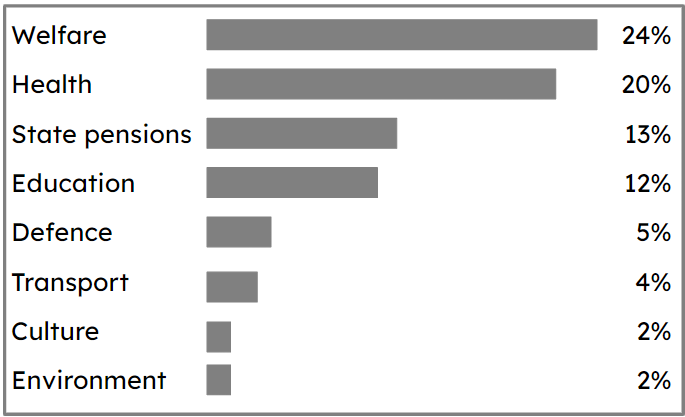
      The UK government distributed approximately £720 billion to the a number of sectors. How much money does "Transport" receive?

      An image in a quiz
      £14.4 billion
      Correct answer: £28.8 billion
      £93.6 billion
      £144 billion

      To help you plan your 8 maths lesson on: Finding a percentage with a multiplier, download all teaching resources for free and adapt to suit your pupils' needs...