Choose exam board for KS4 Computer Science (GCSE)
Choose exam board for KS4 English
Choose exam board for KS4 French
Choose exam board for KS4 Geography
Choose exam board for KS4 German
Choose exam board for KS4 History
Choose tier for KS4 Maths
Choose exam board for KS4 Music
Choose exam board for KS4 Physical education (GCSE)
Choose exam board for KS4 Religious education (GCSE)
Choose exam board for KS4 Spanish

      Estimating lung volume

      Lesson details

      Learning outcome

      I can describe how to use simple apparatus to estimate lung volume.

      Key learning points

      1. The vital capacity of the lungs is the maximum volume of air that can be exhaled after inhaling fully.
      2. How to measure vital capacity using simple apparatus.
      3. The closer a measurement is to the true value, the more accurate it is said to be.
      4. An estimate is an approximate (rough) value of a quantity (without taking accurate measurements).
      5. An estimate of lung volume can be calculated from a measurement of vital capacity.

      Keywords

      • Volume - The amount of three-dimensional space occupied by a substance; usually measured in cm³.

      • Vital capacity - The maximum volume of air that can be breathed out after breathing in fully.

      • Accurate - The closer a measurement is to the true value, the more accurate it is said to be.

      • Meniscus - The surface of a liquid, which may appear curved.

      • Estimate - An approximate (rough) value of a quantity (obtained without taking accurate measurements).

      Common misconception

      Using the term 'accurate' without understanding what it means in relation to scientific measurements. Thinking that an estimate is just a guess.

      The lesson explores the concepts of 'accurate' and 'estimate' using simple apparatus to estimate the vital capacity of the lungs.

      Teacher tip

      The apparatus is simple enough that the experiment could be done at home. In this case, the measuring cylinder could be swapped for a measuring jug, and the ideas about accuracy and estimates would still apply. A video of the use of a measuring cylinder is included in any case.

      Equipment

      See additional materials.

      Content guidance

      Risk assessment required - equipment

      Supervision

      Adult supervision required

      Licence

      This content is © Oak National Academy Limited (2026), licensed on Open Government Licence version 3.0
      except where otherwise stated. See Oak's terms & conditions
      (Collection 2).

      Lesson video

      Loading...

      Prior knowledge starter quiz

      6 Questions

      Q1.
      Humans can’t stay underwater for too long because we need to breathe in ...

      Correct Answer: air, oxygen

      Q2.
      When we breathe in, air moves into the ...

      brain
      heart
      Correct answer: lungs
      stomach

      Q3.
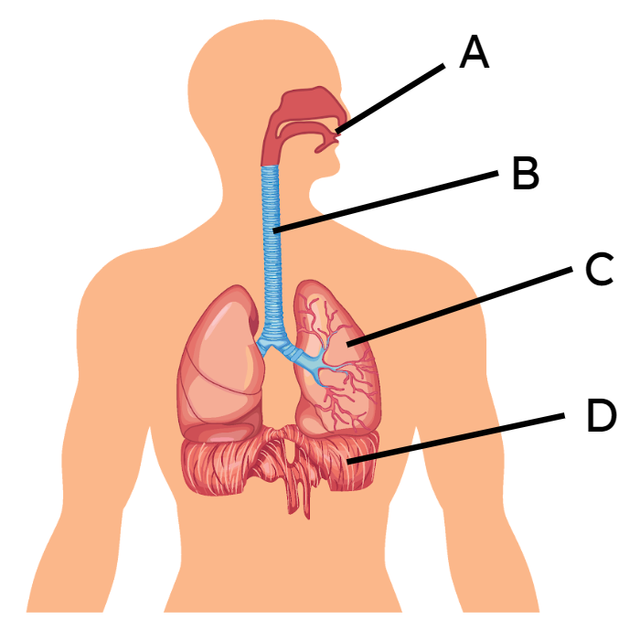
      Which part is a lung?

      An image in a quiz
      A
      B
      Correct answer: C
      D

      Q4.
      Which scientific word means "breathe in”?

      exhale
      Correct answer: inhale
      respiration

      Q5.
      When we breathe in, the volume of the lungs ...

      decreases.
      Correct answer: increases.
      stays the same.

      Q6.
      The lungs are not a big hollow bag, they are divided into tiny air sacs called ...

      Correct Answer: alveoli, alveolus

      6 Questions

      Q1.
      What happens when we exhale?

      air moves into our lungs
      all of the air moves out of our lungs so they are totally empty
      Correct answer: most of the air moves out of the lungs but some stays behind

      Q2.
      Who correctly explains what is meant by the volume of a liquid or gas?

      Jun: “It means how loud the liquid or gas is.”
      Lucas: “It means the height of the liquid or gas.”
      Correct answer: Aisha: “It means how much 3D space the liquid or gas takes up."

      Q3.
      The maximum volume of air you can breathe out after breathing in fully is called your vital ...

      Correct answer: capacity
      estimate
      quantity
      volume

      Q4.
      Which units do we use when writing down a measurement of the volume of a liquid or gas?

      cm
      $$cm^2$$
      Correct answer: $$cm^3$$
      $$cm^4$$

      Q5.
      The closer a measurement is to the true value, the more it is said to be.

      Correct Answer: accurate

      Q6.
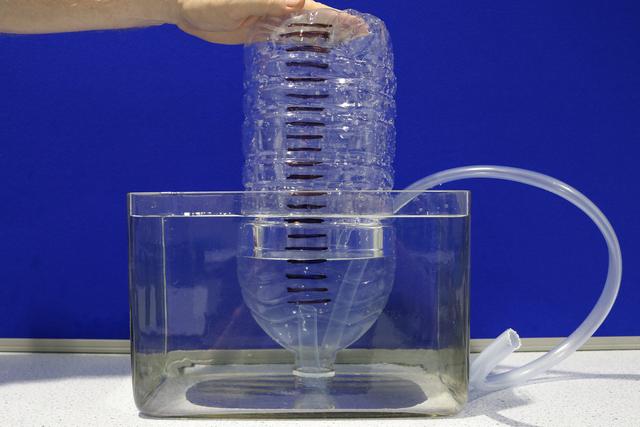
      After Sam exhaled into the tube, the water level in the bottle dropped by 17 lines. Each gap between lines represents 200 $$cm^3$$. Jacob’s vital capacity is $$cm^3$$.

      An image in a quiz
      Correct Answer: 3400, 3,400

      To help you plan your 9 science lesson on: Estimating lung volume, download all teaching resources for free and adapt to suit your pupils' needs...