


Summer plans: 'ir' + a + infinitive




Lesson details
Learning outcome
I can use the verb 'ir' to say where I or we go and what I or we are going to do in the summer.
Vocabulary and transcripts for this lessons
Key learning points
- In Spanish, the SSCs [ce], [ci], and [z] are pronounced differently in different parts of the Spanish-speaking world.
- 'Ir + a + infinitive' is a 2-verb structure used to say what someone is going to do.
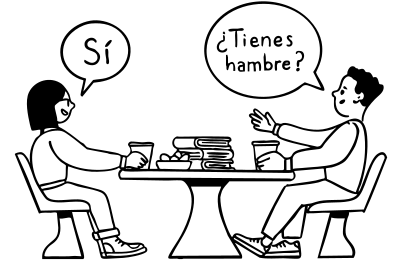
- A question is ‘closed’ when its answer is either ‘yes’ or ‘no’.
- A statement is changed into an intonation question in Spanish simply by raising the tone of voice at the end.
Keywords
[ce] [ci] [z] - pronounced as in 'centro', 'decir' and 'zapato', and differently in different parts of the Spanish-speaking world
Ir + a + infinitive - 2-verb future structure meaning 'going to + infinitive'
Closed question - question that gets the answer 'yes' or 'no' and is created in Spanish by raising the tone of voice at the end of a statement
Common misconception
We swap the verb and subject around to ask a closed, yes/no question as in English, e.g. 'Are we going to go on holiday?'
All closed questions in Spanish have the same word order as the equivalent statement, e.g.'Vamos a ir de vacaciones' ('We are going to go on holiday') → '¿Vamos a ir de vacaciones?' ('Are we going to go on holiday?').
Teacher tip
If schools organise any trips or activities days in the summer term for their Y7 cohort, they might want to adapt the focus of this lesson to adapt the lesson for their context and talk about the activities that pupils are going to do during this time.

Licence

Lesson video
Loading...
Some of our videos, including non-English language videos, do not have captions.
Prior knowledge starter quiz
6 Questions
Q1.In which words is the [c] pronounced like [z] in Spanish?
Q2.Where are the [ce] [ci] and [z] sounds pronounced like [s] in Spanish?
Q3.Match the Spanish and English.

Q4.Match the Spanish and English.
Q5.Write 'abroad' in Spanish.
Q6.Complete the sentence: 'La madre de mi , Lucía, es la hermana de mi madre.'
Assessment exit quiz
6 Questions
Q1.In Latin America, the Canary Islands and some parts of southern Spain, [ce], [ci] and [z] are pronounced like .
Q2.Which is the structure for future plans using 'going to'?
Q3.'Voy a escuchar música'. Choose the correct translation.
Q4.How do you make a closed question from a statement in Spanish?
Q5.Write in Spanish: 'We go to the beach'.
Q6.Write in Spanish: 'We are going to eat'.
To help you plan your 7 Spanish lesson on: Summer plans: 'ir' + a + infinitive, download all teaching resources for free and adapt to suit your pupils' needs...
To help you plan your 7 Spanish lesson on: Summer plans: 'ir' + a + infinitive, download all teaching resources for free and adapt to suit your pupils' needs.
The starter quiz will activate and check your pupils' prior knowledge, with versions available both with and without answers in PDF format.
We use learning cycles to break down learning into key concepts or ideas linked to the learning outcome. Each learning cycle features explanations with checks for understanding and practice tasks with feedback. All of this is found in our slide decks, ready for you to download and edit. The practice tasks are also available as printable worksheets and some lessons have additional materials with extra material you might need for teaching the lesson.
The assessment exit quiz will test your pupils' understanding of the key learning points.
Our video is a tool for planning, showing how other teachers might teach the lesson, offering helpful tips, modelled explanations and inspiration for your own delivery in the classroom. Plus, you can set it as homework or revision for pupils and keep their learning on track by sharing an online pupil version of this lesson.
Explore more key stage 3 Spanish lessons from the Places and plans: 'ir' for present and future plans unit, dive into the full secondary Spanish curriculum, or learn more about lesson planning.