Conditional probability in a two-way table
I can calculate a conditional probability from a two-way table.


- Year 11
Conditional probability in a two-way table
I can calculate a conditional probability from a two-way table.
Lesson details
Key learning points
- A two-way table can be used to calculate conditional probabilities
- A two-way table can be used to calculate conditional probabilities involving sets of events
- Two-way tables allow us to identify which events are mutually exclusive
- Two-way tables can be used to identify which events are independent
Keywords
Conditional probability - Conditional probability is the probability of an outcome occurring given that another event has occurred.
Mutually exclusive - Mutually exclusive events have no outcomes in common.
Independent events - Event A is independent of event B if the probability of event A occurring is not affected by whether or not event B occurs.
Common misconception
Pupils may conflate the meaning of mutually exclusive with the meaning of independent.
Emphasise the word 'exclusive' in 'mutually exclusive' to suggest that one event excludes the other. Also, emphasise that the opposite of independent is dependent.


Licence
Lesson video
Loading...
Prior knowledge starter quiz
6 Questions
Q1.Which symbol is used to represent the union of two sets?

Q2.What does this symbol represent: ' ?
Q3.What region is shown shaded in this Venn diagram?
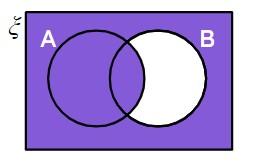
Q4.ξ = {1, 2, 3, 4, 5, 6, 7, 8, 9, 10, 11, 12}, A = {multiples of 4}, B = {factors of 12}. Find P(A' ∩ B').
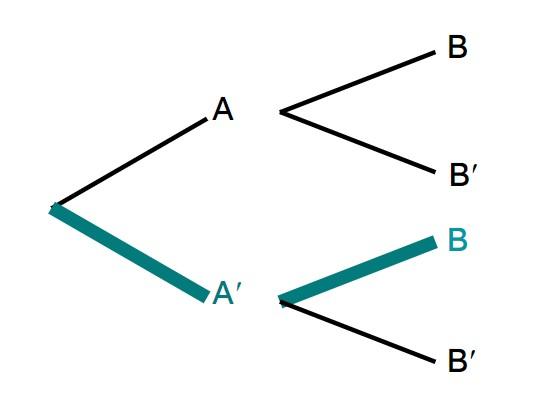
Q5.Which combination of events is highlighted in the tree diagram?
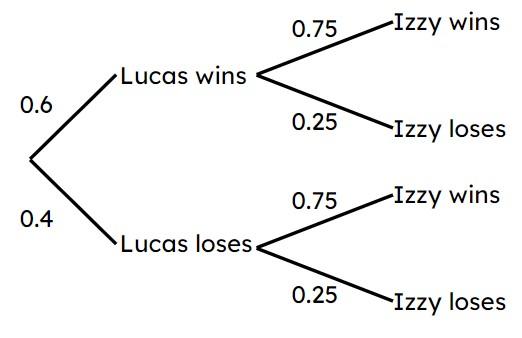
Q6.Lucas and Izzy each play one game of chess that they can either win or lose. P(Lucas wins ∩ Izzy wins) = (give your answer as a decimal).
Assessment exit quiz
6 Questions
Q1.The probability of an outcome occurring given that another event has occurred is called probability.
Q2.Select the example of events which are not independent.
Q3.The table shows the types of marble in a bag. Match each event to its probability.
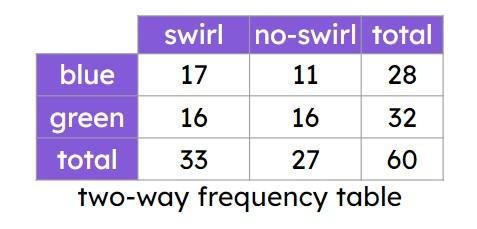
P(blue) - $$28\over 60$$
P(green) - $$32\over 60$$
P(blue and has no swirl) - $$11\over 60$$
P(blue given it has no swirl) - $$11\over 27$$
P(green and has a swirl) - $$16\over 60$$
P(green given it has swirl) - $$16\over 33$$
Q4. A marble is taken at random from a box of blue and green marbles. Alex works out that P(swirl and blue) = 0. This shows the event 'taking a blue marble' and the event 'taking a swirl marble' are...
Q5.A 20-sided die with integers from 1 to 20 written on it is rolled once. Select the pair of mutually exclusive events.
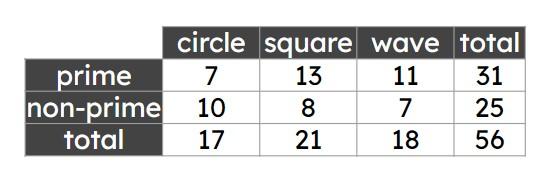
Q6.A deck of cards has a number on it (either prime or non-prime), and a symbol (a circle, square, or wave). A card is selected at random from the deck. Find P(square | prime).