


What can we do as active citizens to improve our community?
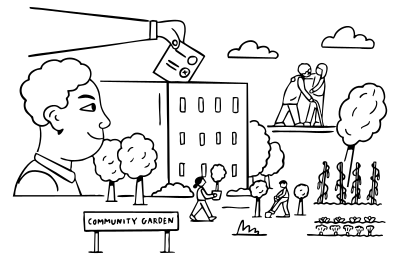


Lesson details
Learning outcome
I can describe what we can do as active citizens to improve our community.
Key learning points
- Active citizenship involves key skills such as advocacy, collaboration and political literacy.
- Engaging in democracy and contributing to lasting change are essential aspects of being an active citizen.
- Active citizens identify community issues, seek help from relevant resources and decide effective actions for campaigns.
- Planning and measuring the success of a campaign are crucial steps in creating a positive impact on the community.
- Active citizenship does not have to be too hard if you work collaboratively to divide the work between group members.
Keywords
Active citizenship - the process of learning how to take part in democracy and use Citizenship knowledge, skills and understanding to work together and try to make a positive difference in the world
Campaign - an action or event organised by an individual or a group of people to achieve an aim
Active citizen - a person who actively takes responsibility, becomes involved in areas of public concern and tries to make a positive difference in their community
Common misconception
Active citizenship campaigns are not part of democracy.
If you work together effectively, active citizen campaign tasks are an important form of taking part in democracy.
Teacher tip
This lesson is the first of a two part lesson but can also be used as a standalone lesson if required. It is important to research issues in your local community before this lesson so campaigns can be relevant, engaging and interesting.

Content guidance
Depiction or discussion of sensitive content

Supervision
Adult supervision recommended

Licence

Lesson video
Loading...
Prior knowledge starter quiz
6 Questions
Q1.Changemakers are people who make what sort of change in a community?
Q2.What do campaigners, volunteers, NGOs and charities spark in communities?
Q3.What is the definition of a protest?
Q4.Democratic activities include:
Q5.Which group of people are more likely to use social media more than others to inspire change?
Q6.Match the campaign method with its purpose.

Assessment exit quiz
6 Questions
Q1.Which skill is not important for an active citizenship campaign?
Q2.By improving your citizenship skills, you can become an active citizen and improve your ...
Q3.What do citizenship skills equip us to be?
Q4.What do you have to engage in to become an active citizen?
Q5.It is important that active citizenship leads to change.
Q6.Match the stage with the active citizenship process.
To help you plan your 7 citizenship lesson on: What can we do as active citizens to improve our community?, download all teaching resources for free and adapt to suit your pupils' needs...
To help you plan your 7 citizenship lesson on: What can we do as active citizens to improve our community?, download all teaching resources for free and adapt to suit your pupils' needs.
The starter quiz will activate and check your pupils' prior knowledge, with versions available both with and without answers in PDF format.
We use learning cycles to break down learning into key concepts or ideas linked to the learning outcome. Each learning cycle features explanations with checks for understanding and practice tasks with feedback. All of this is found in our slide decks, ready for you to download and edit. The practice tasks are also available as printable worksheets and some lessons have additional materials with extra material you might need for teaching the lesson.
The assessment exit quiz will test your pupils' understanding of the key learning points.
Our video is a tool for planning, showing how other teachers might teach the lesson, offering helpful tips, modelled explanations and inspiration for your own delivery in the classroom. Plus, you can set it as homework or revision for pupils and keep their learning on track by sharing an online pupil version of this lesson.
Explore more key stage 3 citizenship lessons from the How can we make a difference in our communities? unit, dive into the full secondary citizenship curriculum, or learn more about lesson planning.